Energy
Future-Proofing the Sustainable Workplace: Integrating Solar PV and Smart EV Infrastructure

The Core Infrastructure of a Modern Green Business
We have talked about a lot of things on the Blue and Green Tomorrow blog over the years, but renewable energy is one of our favorite topics. It is especially important for workplaces that want to prepare for cleaner transportation, lower energy costs, and stronger long-term sustainability plans.
Jonathan Fenoll of Solar Today Magazine writes that, according to the Solar Energy Industries Association, the number of solar businesses in the U.S. now exceeds 10,000, supporting jobs in research and development, manufacturing, installation, and maintenance. Something that makes this important is that solar PV is no longer a niche workplace upgrade, since the industry is growing and giving businesses more practical options for clean power. Keep reading to learn more.

Solar PV and Smart EV Charging Can Help Workplaces Prepare for the Future
“Government policies, particularly the Inflation Reduction Act (IRA), have accelerated the U.S. solar market’s expansion. According to the American Clean Power Association, at least 160 clean energy manufacturing facilities or expansions have been announced since August 2022, driven by tax credits in the IRA, with 47 announced in 2024 alone. Prior to these incentives, the U.S. ranked seventh globally in module manufacturing capacity. Today, it has risen five-fold to reach third place, demonstrating the impact of strategic investments in clean energy infrastructure. This growth extends beyond just solar panels; the industry supports a robust supply chain that includes storage solutions, mounting systems, power electronics, and other key components,” Fenoll says.
Solar PV can help businesses reduce their dependence on traditional power sources while giving employees, visitors, and fleet vehicles cleaner ways to charge. There are many reasons workplaces are pairing solar panels with smart EV chargers, including lower long-term energy exposure, stronger climate planning, and better control over power use.
Smart EV infrastructure also helps companies prepare for a future where more employees and customers drive electric vehicles. Another thing it can do is help facilities manage charging times, reduce peak demand pressure, and make better use of solar power produced during the day. It is easier for a workplace to support electric transportation when charging is planned as part of a broader energy strategy.
Mark Segal of ESG Today writes that 85% of companies increased sustainability investments over the past year. Something that makes this trend important is that companies are looking for projects that can create practical business benefits, not just better public messaging.
“While executives reported becoming more concerned about climate change, however, the report found that they are also increasingly focused on opportunities to achieve direct benefits to their businesses through their sustainability-related investments and initiatives. Material benefits such as supply chain efficiency and resilience and operating margins ranked within the top 5 benefits already being experienced by companies as a result of their sustainability efforts, compared with less tangible benefits such as brand recognition and reputation reported in the prior year survey. Notably, nearly half of respondents said that their companies are already taking action on developing new climate-friendly products or services,” Segal writes.
Workplaces that combine solar PV with smart EV charging can create cleaner, more practical energy systems for daily operations. There are many ways this can help, from powering commuter charging stations to supporting electric delivery fleets and company vehicles. Something that makes this approach useful is that businesses can monitor energy use and charging needs instead of treating electricity as a fixed expense. Another thing leaders can do is plan upgrades in stages as demand for EV charging grows.
A sustainable workplace is not only about installing new equipment. It is about making choices that support employees, customers, operating budgets, and long-term climate goals. Another thing businesses should consider is whether their buildings, parking areas, and electrical systems are ready for the next wave of clean transportation.
For decades, corporate sustainability was defined by surface-level initiatives. Implementing paperless office policies or comprehensive recycling programs were considered the peak of corporate social responsibility.
Today, these measures are merely table stakes. True operational sustainability in the modern era relies fundamentally on achieving Energy Independence.
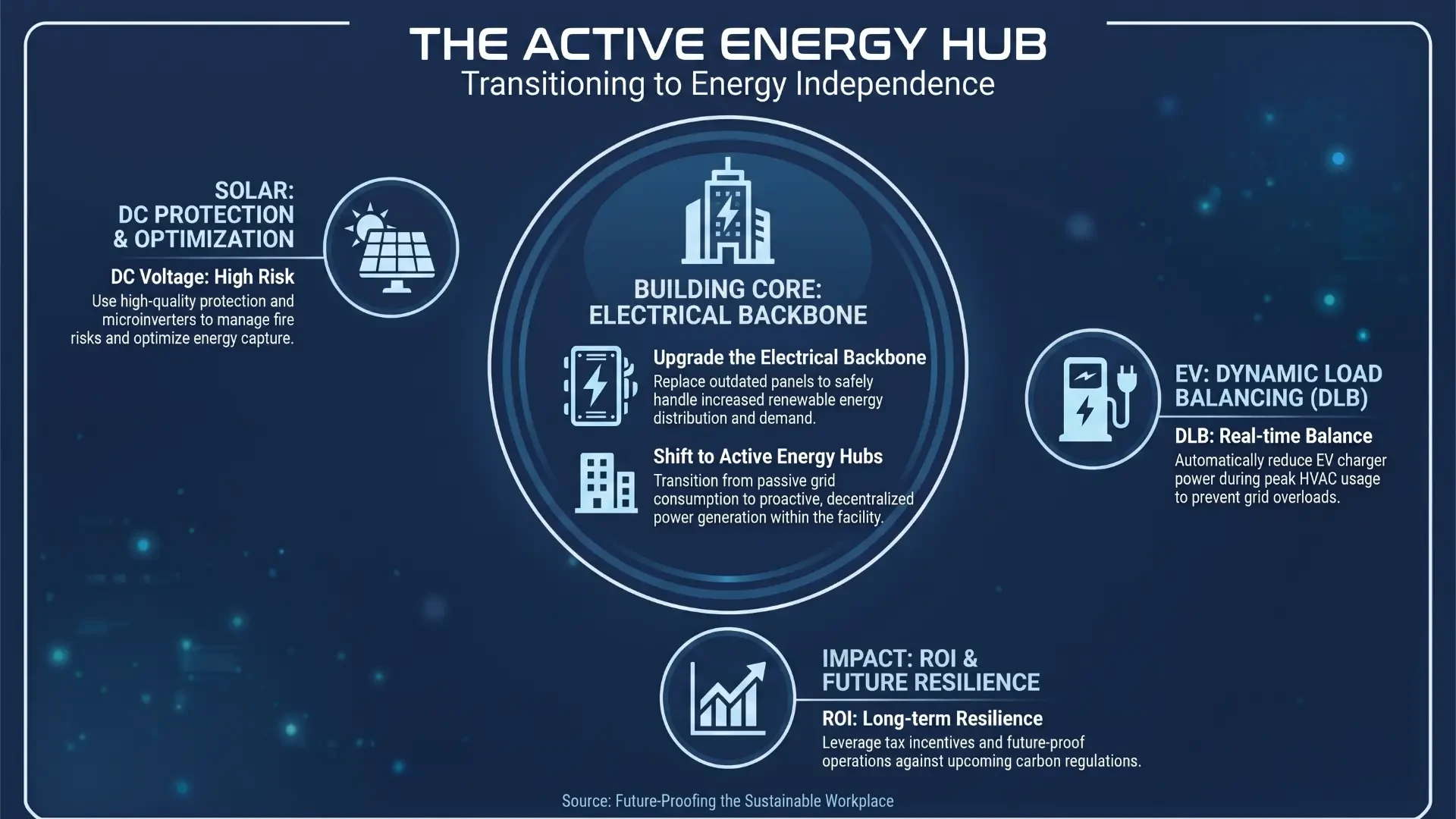
This shift requires facility managers to look beyond administrative policies and fundamentally upgrade their building’s core electrical backbone. To support a genuinely green operation, older electrical panels and outdated power distribution networks must be replaced.
As businesses transition to genuinely green operations, upgrading the underlying electrical infrastructure is non-negotiable. To safely handle the increased energy demands of modern sustainability initiatives, facility managers are increasingly investing in robust BENY solar and EV charging solutions, ensuring that the workplace can efficiently distribute renewable energy while supporting employees’ transition to zero-emission commuting.
This integration transforms a static office building into an active energy hub. It signals a move away from passive grid consumption toward proactive, decentralized power generation.
Safely Harnessing On-Site Solar Power
The commercial adoption of rooftop photovoltaics (PV) and large-scale battery storage has accelerated dramatically. Businesses are utilizing their vast roof spaces to generate localized, renewable power, cutting utility costs simultaneously.
However, generating commercial-scale solar power introduces complex electrical safety requirements. Direct current (DC) voltages from commercial arrays are extremely high and pose significant fire risks if not properly managed.
High-quality DC protection components are critical to safeguarding both the facility and its occupants. Essential safety mechanisms include:
- Industrial-grade DC circuit breakers to prevent overcurrent scenarios.
- Rapid shutdown devices that de-energize panels instantly during emergencies.
- Surge protective devices (SPDs) to shield sensitive electronics from lightning strikes.
Furthermore, integrating Microinverters directly at the panel level can optimize energy capture while enhancing safety. Unlike traditional string systems, these devices convert DC to AC power on the roof, significantly reducing high-voltage DC runs through the building.
When safety is prioritized, commercial solar installations boast significantly longer lifespans. This preventative approach to thermal management and electrical protection drastically reduces long-term maintenance costs.
Empowering the Green Commute with Intelligent Charging
The Role of Dynamic Load Balancing (DLB)
Electrifying the corporate parking lot is a massive undertaking that goes far beyond simply plugging hardware into the wall. Adding multiple electric vehicle (EV) chargers can place catastrophic stress on a building’s existing grid capacity.
This is where Dynamic Load Balancing (DLB) becomes an essential technology for facility managers. DLB systems continuously monitor the building’s overall power consumption in real-time.
When the building’s energy demand spikes—such as during peak summer HVAC usage—the DLB system automatically reduces the power flowing to the EV chargers. It prevents grid overloads without tripping main breakers.
Key benefits of deploying intelligent DLB infrastructure include:
- Avoiding expensive utility demand charges during peak operational hours.
- Eliminating the need for costly, disruptive main utility transformer upgrades.
- Ensuring equitable power distribution across all plugged-in employee vehicles.
Encouraging Employee EV Adoption
The availability of reliable workplace charging is a primary catalyst for employees transitioning to electric vehicles. Range anxiety remains a significant barrier for many drivers considering zero-emission transport.
By providing dependable, intelligent charging infrastructure, companies directly influence their workforce’s commuting habits. It removes the logistical friction of EV ownership for staff members who may lack home charging capabilities.
This reliable infrastructure acts as a highly visible, daily reinforcement of the company’s environmental commitments. It transforms sustainability from an abstract corporate goal into a tangible, everyday employee benefit.
The Macro Environmental Impact of Workplace Electrification
Upgrading facility infrastructure yields immediate localized benefits, but its true value lies in addressing global climate goals. The commercial transition to decentralized renewable energy is critical for reducing national carbon footprints.
The push for corporate sustainability extends far beyond public relations and employee perks; it is a vital component of meeting global climate targets.
According to national environmental data, the commercial and industrial sectors contribute significantly to overall greenhouse gas emissions, making the rapid integration of on-site renewable generation and electrified transport critical steps in mitigating climate change.
Investing in these technologies also offers a compelling long-term Return on Investment (ROI). Facility managers who act proactively can leverage tax incentives and future-proof their operations against impending carbon regulations.
Key Takeaways
| Area | Key Takeaway | Impact/Data |
| Solar Safety | Install DC protection | Prevent fatal fires |
| EV Charging | Deploy DLB systems | Stop grid overloads |
| Power Grid | Cap peak energy draw | No costly upgrades |
| Compliance | Act for tax benefits | Beat carbon rules |
Conclusion: A Resilient, Zero-Carbon Corporate Future
Solar PV and smart EV infrastructure can help companies make their workplaces cleaner, more practical, and better prepared for the future. It is a strong option for businesses that want to reduce emissions while making their facilities more useful for employees and visitors.
Companies that plan these upgrades carefully can gain more control over energy use and transportation needs. There are many benefits to taking action early, especially as solar adoption grows, EV ownership rises, and sustainability investments become a larger part of business planning. Something that matters most is building workplace systems that can keep serving the company as energy needs change.
The modern business landscape requires a physical infrastructure that reflects an urgent commitment to the environment. Integrating solar PV with intelligent EV charging creates a self-sustaining ecosystem right at the workplace.
This strategy seamlessly bridges the gap between corporate social responsibility (CSR) and measurable economic efficiency. Ultimately, adapting to these advanced energy standards is the most effective way to secure a resilient, zero-carbon future for any commercial enterprise.