


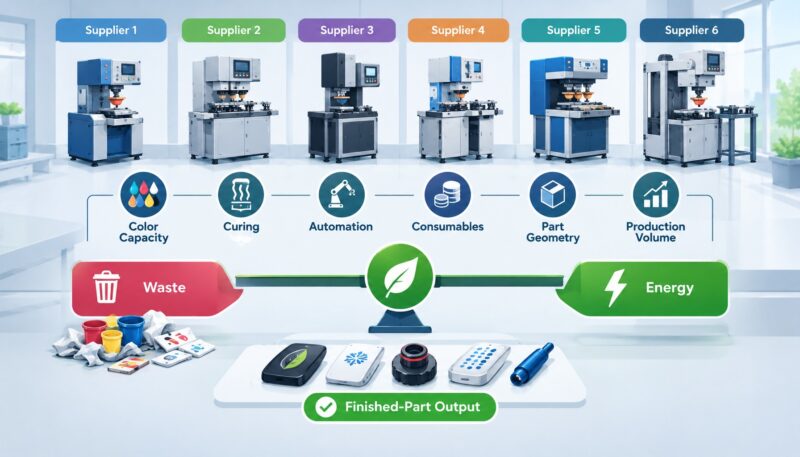
Sustainable pad printing equipment choices depend on matching color capacity, curing, automation, and consumables to part geometry and production volume. Additional stations and handling equipment change the waste and energy calculation. Compare setup losses, registration rejects, and curing requirements alongside finished-part output when evaluating a configuration.
- Compare color-station requirements and curing arrangements against the actual artwork.
- Include pad and cliché changeovers, setup rejects, and consumable draw in the production assessment.
- Treat automation and special-purpose configurations as application choices. The supplier list does not establish a measured energy-efficiency ranking.
Setup scrap, discarded ink, curing energy, and rejected parts all contribute to a pad printer’s operating costs. Equipment selection affects each of them. This comparison examines six industrial suppliers through those costs, with attention to how the printer, consumables, tooling, and handling arrangements work together on your actual parts.
Six suppliers, different evaluation priorities: Diverprint offers equipment and consumables across configured applications. ITW Trans Tech offers customized training and performance audits. EPS covers benchtop equipment through automated cells, while Teca-Print brings a contract-printing perspective. Deco Tech supplies equipment and cliché services; Impression Technology provides a single-color entry point for comparison.
- Compare color-station requirements and curing arrangements against the actual artwork.
- Include pad and cliché changeovers, setup rejects, and consumable draw in the production assessment.
- Treat automation and special-purpose configurations as application choices. The supplier list does not establish a measured energy-efficiency ranking.
Why Decoration Choices Drive Waste and Energy Use
Pad printing transfers ink from an engraved cliché to a part using a silicone pad. For manufacturers decorating irregular components, pad contact and repeatable positioning determine whether the image transfers correctly. Setup losses arise at that transfer stage; treatment and curing add energy requirements elsewhere in the workflow.
A technical overview of pad printing explains the transfer mechanics. Curved, concave, and textured components can suit the process, although pad access still limits what can be printed. A deep recess or extreme undercut can prevent contact with the intended surface.
More colors introduce additional registration requirements and consumable use. Depending on the configuration and ink system, they can also require additional stations or curing steps. A rejected part carries the ink and processing energy already spent on it. Plates and pads also contribute to consumable waste as they wear or require replacement.
The ink must suit the substrate, the pad must reach the image location, and the fixture must hold the part consistently. Surface treatment, curing, and handling then have to preserve that result. Programmable settings or automated handling can address repeatability problems, but they cannot compensate for an unsuitable pad shape or incompatible ink.
How This Comparison Was Built
This comparison addresses industrial buyers in the United States and North America. It examines machine range, color capacity, automation, tooling, consumables, and application support for their relevance to waste and energy use. Supplier capabilities identify configurations worth evaluating; they do not establish comparable electricity consumption or scrap rates.
The six suppliers below remain the focus of the original comparison. Model-level specifications retained from that review are identified as such where current confirmation is unavailable. Actual output depends on artwork, fixtures, preparation, handling, and curing. No common production test supports an environmental ranking across these companies.
| Option | What the article says |
|---|---|
| Diversified Printing Techniques | Diversified Printing Techniques, also known as Diverprint, supplies equipment, automation, and consumables for the same printing workflow. |
| ITW Trans Tech | ITW Trans Tech offers manual, semi-automatic, and fully automated single- and multi-color systems, plus tooling and consumables. |
| Engineered Printing Solutions | Engineered Printing Solutions , or EPS, supplies pad printers from benchtop machines to fully automated cells. |
| Teca-Print USA | Teca-Print USA supplies industrial machines, inks, cliché plates, and silicone pads, alongside the contract-printing services described in the original review. |
| Deco Tech Group | Deco Tech Group supplies pad printing equipment, consumables, and services including cliché etching. |
| Impression Technology USA | Impression Technology USA appeared in the original review as an entry-level comparison for single-color equipment, with manual and automatic models. |
1. Diversified Printing Techniques
Diversified Printing Techniques, also known as Diverprint, supplies equipment, automation, and consumables for the same printing workflow. Its pad printing machine lineup spans single-color, multi-color, integration, and modular categories. That scope makes it relevant when setup waste involves several interacting components, such as a pad, fixture, and ink system that do not yet produce a repeatable image.
Diverprint’s application guidance identifies automation, regular maintenance, high-quality pads, and precise ink-viscosity control as ways to improve efficiency and print quality. These address ink transfer and repeatability. They do not establish an energy saving for a particular machine, and curing remains part of the application-level comparison.
- Hundreds of pad shapes developed in varied sizes.
- Standard and anti-static platinum rubber pad systems.
- Photopolymer, laser, thin steel, and thick steel plate options.
Medical, automotive, electronics, appliance, sporting-goods, and promotional-product applications can involve different substrates and image locations. Diverprint’s relevance is the ability to discuss the printer alongside pad shape, cliché, ink, fixtures, surface treatment, and automation. The waste and energy outcome still depends on the configuration selected for that application.
2. ITW Trans Tech
ITW Trans Tech offers manual, semi-automatic, and fully automated single- and multi-color systems, plus tooling and consumables. Its customized training and performance audits are offered for specific production environments. Those services are relevant when your team is investigating setup or output problems, although the service description supplies no quantified waste-reduction result.
The original review also reported the following capabilities and specifications. The color target and production rate describe particular supplier claims, not a comparison of environmental performance.
- More than 40 years of stated pad-printing experience.
- Automation options that can include feeding, nesting, pre-treatment, post-treatment, and vision inspection.
- A published color-matching target of Delta E variance of 2.0 or less for its ink batches.
- MKM equipment literature lists up to 800 pieces per hour in four colors for the MKM 80 under stated operating conditions.
3. Engineered Printing Solutions
Engineered Printing Solutions, or EPS, supplies pad printers from benchtop machines to fully automated cells. The original review described its electro-pneumatic KP series as eight models, KP04 through KP16, with one- to five-color configurations. Stored settings address repeat setup work; cleaning, drying, and handling options also change the equipment included in the energy calculation.
The following model details are retained from the original review. They are configuration-specific specifications, not measured waste or energy benchmarks.
- Digital HMI controls with storage for up to 99 program settings on applicable models, which shortens changeover and cuts setup scrap.
- Published cycle rates of up to 2,000 cycles per hour for selected KP equipment.
- KP13 configurations support one to five colors and are listed at up to 1,000 parts per hour.
- KP16 supports up to five colors and can be paired with cleaning, pre-treatment, drying, pick-and-place, and conveyor options.
4. Teca-Print USA
Teca-Print USA supplies industrial machines, inks, cliché plates, and silicone pads, alongside the contract-printing services described in the original review. A pad printing service offers another route for examining a difficult decoration project. For recessed or multi-location images, the useful comparison concerns pad access, repositioning, and rejected parts across the proposed arrangements.
- Supports single-color, multi-color, in-line, multi-pad, rotational, and multi-location printing.
- Offers high-volume pad printing capabilities.
- Works across electrical, telecommunications, cosmetics, personal care, pharmaceutical, medical, food-packaging, and promotional applications.
- Provides machinery, inks, additives, and other consumables.
5. Deco Tech Group
Deco Tech Group supplies pad printing equipment, consumables, and services including cliché etching. The original review described more than 35 years of experience and a portfolio including Swiss-engineered microPrint systems and Deco Tech printers. Its guidance identifies deep recesses and extreme undercuts as possible barriers to pad contact, a concrete limitation when evaluating where setup trials may fail.
- Equipment intended for plastics, metals, and medical devices.
- Support for automotive, medical, toy, promotional, and electronics-related applications.
- Access to machinery and technical expertise from one supplier.
6. Impression Technology USA
Impression Technology USA appeared in the original review as an entry-level comparison for single-color equipment, with manual and automatic models. Published purchase prices can help scope an initial equipment budget. They leave the ink, setup scrap, and curing requirements unresolved, so the manual-to-automatic comparison still depends on your production workflow.
- The original review identified the manual TIC175H and automatic PRU1; current prices are not reproduced here.
- The original review reported ink-cup sizes from 55 mm to 180 mm across its listed models; current model availability remains unconfirmed.
- Machines can be customized with automated loading systems and project-specific features.
What To Compare Before Buying
Compare configurations against the same part, artwork, and finished-quality requirements. For your production team, the deciding variables include color stations, pad access, changeover frequency, and curing arrangements. An added mechanism may address handling or registration problems while introducing another energy demand; both effects belong in the equipment comparison.
- Part geometry: Pad access comes before cycle rate. Deco Tech’s limitations guidance identifies deep recesses and extreme undercuts as possible obstacles to contact. Trial rejects on those features belong in the configuration assessment.
- Color-station count: Match stations to the artwork and registration requirements. Published machines span different color capacities, and pad-printing limitations guidance notes that high color counts can slow the process. Additional curing depends on the selected ink and process.
- Special-purpose configurations: In-line, multi-pad, rotational, and multi-location arrangements address different image locations and handling needs. Compare their potential to avoid repositioning rejects against the equipment and curing they add. No common energy benchmark establishes a preferred arrangement across these suppliers.
- Pad and cliché changeovers: Frequent job changes make setup losses part of the comparison. Replacement frequency, pad condition, and ink-viscosity control deserve attention alongside stored settings. Diverprint’s application guidance connects maintenance, pad quality, and viscosity control to efficiency and print quality.
- Adhesion and curing: Ink compatibility determines which treatment and curing arrangements are relevant. Engyprint’s sustainability guidance identifies energy-efficient equipment, including LED curing systems, as an option. Suitability depends on the application; it is not a universal substitution for existing curing equipment.
- Production support: Include consumables, maintenance, and operator support in the comparison. Trans Tech offers customized training and performance audits. The availability of those services does not establish a particular reduction in scrap.
Final Recommendation
Select a configuration that holds image quality, adhesion, and finished-part output while controlling setup waste and curing demand. Across these six suppliers, equipment scope helps identify a fit. Actual environmental performance depends on the part and process, with no verified comparative energy measurements establishing a winner.
A repeat job can still lose material when ink transfer drifts. For your team, pad condition and ink viscosity are concrete checkpoints supported by Diverprint’s application guidance, especially when registration or transfer quality changes after setup. Curing belongs in the same assessment, with energy-efficient options considered where compatible. Keep the printer, treatment equipment, and drying arrangements together in the comparison so a faster printing cycle does not conceal rejected parts or an unsuitable cure process.
Frequently Asked Questions
How does pad printing equipment affect material waste and energy use?
Setup scrap, discarded ink, curing energy, and rejected parts all contribute to a pad printer’s operating costs. Equipment selection affects each of them. Sustainable pad printing equipment choices depend on matching color capacity, curing, automation, and consumables to part geometry and production volume.
What should buyers compare before choosing pad printing equipment?
Compare each configuration against the same part, artwork, and quality requirements. Check pad access to the part geometry, match color stations to the artwork, weigh how often pads and cliches change, confirm the ink’s adhesion and curing needs, and include consumables, maintenance, and operator support in the comparison.