


Buyers evaluate sustainable supply chain examples by separating company-wide pledges from facility-level and product-level evidence. Review the exact reporting scope, baseline dates, and calculation boundaries for raw-material processing, supplier energy use, and reusable logistics equipment before accepting a supplier's reduction claim into your procurement file.
A purchasing team can ask for recycled packaging, renewable electricity, and better working conditions in the same contract. Finding out whether those requirements actually changed anything takes more work. These seven sustainable supply chain examples show where companies reported real changes, what their published figures measure, and which ideas a smaller business can put to use. None of them amounts to a clean bill of health for an entire corporation.
Seven company examples at a glance
Comparing corporate disclosures side by side helps procurement teams see what each supplier metric actually measures and where the reporting boundaries sit. The two tables below summarize the specific supply-chain practice, the reported figure from each company’s disclosure, the applicable time period, and where those activities fall across Scope 1, Scope 2, and Scope 3 categories.
| Company | Practice | Reported evidence | Period and limits | What a buyer can use |
|---|---|---|---|---|
| Patagonia | Assess supplier facilities | Raw-material manufacturing: about 90% of the reported footprint. | FY2023 emissions breakdown; a dated baseline. | Look beyond the final assembly factory. |
| Inter IKEA Group | Change supplier energy and materials | Reported purchased-material emissions fell 8%, largely with lower volumes. | FY26 vs FY25; Inter IKEA reporting scope. | Separate production volume from efficiency. |
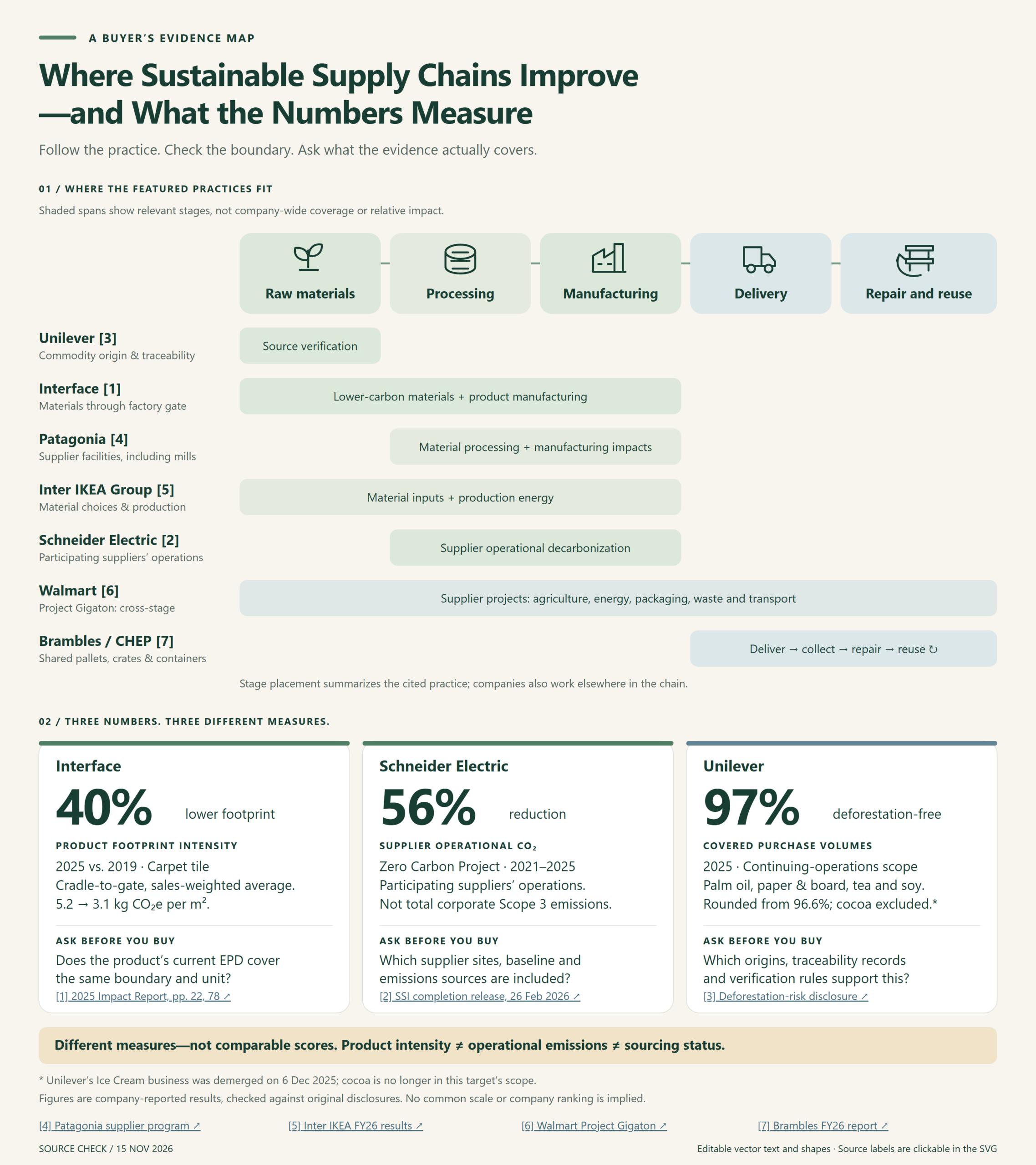
| Schneider Electric | Engage suppliers in emissions cuts | Reported 56% reduction in participating suppliers’ operational CO2. | 2021-2025 program; not total corporate Scope 3. | Connect buyer follow-up to supplier action. |
| Walmart | Project Gigaton reporting | Over 1.37 billion tons CO2e in cumulative reported project benefits. | Through FY2026; includes expected avoided emissions. | Keep project estimates separate from inventories. |
| Interface | Change flooring materials | Reported carpet-tile footprint through the factory gate fell 40%. | 2025 vs 2019; average per square meter. | Compare products over matching lifecycle stages. |
| Unilever | Verify commodity origins | 97% of covered purchase volumes reported deforestation-free. | 2025 continuing operations; defined commodity scope. | Link origin evidence to the material bought. |
| Brambles / CHEP | Pool and return transport equipment | Estimated customer benefit: 2.69 million tons CO2e avoided. | FY26 lifecycle comparison with alternatives. | Measure returns and losses in a route trial. |
Where the work happens. Supplier tiers vary by industry; emissions categories depend on the activity and the reporting company. Scope 2 covers purchased energy, while Scope 3 includes other indirect emissions upstream and downstream.

What these sustainable supply chain examples show
The useful detail in a corporate sustainability report often sits several pages past the headline. A retailer’s supplier project might perform well while its total footprint grows. A product can carry a smaller manufacturing footprint yet still generate heavy emissions when installed or discarded. Read each example below as evidence of a specific practice, with its limits attached.
1. Patagonia follows the fabric beyond the finished garment
For a clothing buyer, the factory sewing the label into a jacket is only one place to look. Patagonia’s FY2023 emissions breakdown attributed 179,119 metric tons of CO2 equivalent to raw-material manufacturing, out of a 200,119-ton reported total. That’s roughly nine-tenths of the footprint in that disclosure. Checking the sewing factory alone misses most of the emissions recorded in that inventory.
Patagonia’s supplier environmental program covers manufacturing facilities and states that it examines chemical use, wastewater, energy, and other impacts. According to the company’s program account, those assessments feed directly into decisions about approving and managing suppliers. This gives a buyer a sharp starting question: who makes the fabric, and what evidence do we hold about that facility? A certificate held by the company selling the finished garment often answers a different question entirely.
An unofficial qualification to become chief executive of Patagonia seems to be an interest in extreme sports, a strong meditation practice or both. The previous C.E.O. practiced Tibetan Buddhism. The one before that was a ski bum who liked to meditate. Yvon Chouinard, the company’s eccentric founder, was a mountain-climbing Zen Buddhist.
David Gelles, Reporter, The New York Times, in The New York Times, 2021
Environmental checks also leave work to do on pay. Patagonia’s living-wage account acknowledges that legal wages can still fall short of what workers need. Ask about wages and working hours separately when reviewing a supplier. Improved water treatment says little about whether the people running the machinery can cover their household costs.
2. Inter IKEA separates cleaner production from buying less
Inter IKEA Group’s FY26 annual report offers a clear lesson in reading a falling emissions number. According to the report, emissions tied to purchased materials fell 8%, largely because purchasing volumes dropped. The reported manufacturing portion fell 20%, a shift the company attributes to lower volumes alongside reduced fossil-fuel use and more renewable electricity among suppliers. Those explanations matter to a buyer trying to figure out what can be repeated.
Owned sites changed too. In its FY26 results, Inter IKEA notes that renewable energy production at IKEA Industry sites rose 46%. It also reports that all electricity consumed in its own operations came from renewable sources, including contractual purchases and renewable energy certificates. That statement covers its own operations; it doesn’t mean every supplier runs on renewable power.
Keep the reporting entity in view. In the company’s reporting structure, Inter IKEA Group and the retailer Ingka Group publish separate accounts, though franchise activities appear within Inter IKEA’s Scope 3 reporting. Its change in climate reporting also affects comparisons with earlier IKEA figures. For your own suppliers, request total emissions and output for the exact same period. A quieter factory can emit less without making each unit any more efficiently.
3. Schneider Electric makes supplier improvement part of purchasing
A supplier questionnaire helps only if somebody acts on the answers. Schneider Electric uses assessments to guide procurement decisions. In EcoVadis’s account of the program, sustainability objectives sit inside procurement scorecards and connect to company-wide performance incentives. This makes the buyer responsible for following up, instead of leaving the supplier’s response in a separate reporting exercise.
Schneider’s 2025 results show a 56% reduction in participating suppliers’ operational CO2 emissions through its Zero Carbon Project, which engaged its top 1,000 suppliers. Keep that context attached to the number. It reflects suppliers’ operations within the program, not a claim that Schneider’s entire supply-chain footprint dropped by 56%.
A smaller company can start with a single supplier that needs help setting a baseline. Agree on which site and energy sources to include, who provides the records, and when the buyer will review progress. If a production upgrade needs capital investment, discuss the purchasing commitment that could back it. Sending the same questionnaire next year won’t fix a missing meter or an unaffordable equipment replacement.
4. Walmart shows why project savings need their own account
According to Walmart’s program disclosures, the company launched Project Gigaton in 2017 to get suppliers to report a billion metric tons of emissions reduced, avoided, or sequestered by 2030. The company announced that suppliers passed that threshold in February 2024. The program gave a massive supplier base a shared platform to report projects and a reason to measure their expected effects.
Walmart’s FY2026 climate disclosures put the cumulative reported figure above 1.37 billion metric tons of CO2 equivalent, with more than 4,300 suppliers reporting progress that year. Yet those same disclosures put Walmart’s estimated Scope 3 emissions at 635 million metric tons, rising as its business grew and its product mix shifted. Both numbers can appear in the same report because they describe different things.
When running a supplier program, keep a project log alongside the company emissions inventory. For each project, state the comparison used, the period covered, and whether the saving has already happened or is expected later. Avoided emissions rely on an estimate of what would have occurred otherwise. You can’t simply subtract them from the emissions your business actually reports.
5. Interface puts material choices into product-level figures
Flooring offers a practical place to examine what goes into a product. Interface’s 2025 Impact Report states that recycled, bio-based, or captured-carbon materials made up 66% of its carpet tiles. It reports that the average carpet-tile footprint through the factory gate fell 40% compared to 2019, down to 3.1 kilograms of CO2 equivalent per square meter. That gives a specifier a sharper metric than asking whether the manufacturer considers itself green.
Ask for the environmental product declaration (EPD) covering the exact flooring you plan to buy. Check the product, region, and lifecycle stages before comparing two figures. Transport and maintenance often sit outside a manufacturing-only number. Expected service life matters too, since replacing a floor early changes the total material a building consumes over time.
The linked CQuest BioX declaration shows why dates deserve the same scrutiny as carbon figures. According to the document, it was issued on October 1, 2021, with a five-year validity period through October 2026. It remains a useful example of the calculation method, though a buyer should request a current declaration for an active specification. A product document proves the numbers for the products and assumptions it names, not every environmental claim the company makes.
6. Unilever works back toward the source of its ingredients
A purchase order can name a trader without telling the buyer where a crop actually grew. Unilever’s reported deforestation work addresses that gap across palm oil, paper and board, tea, soy, and cocoa. Its 2025 annual report records 97% of purchase volumes in those commodities as deforestation-free under its rules for continuing operations. The percentage describes a defined set of purchases instead of every input the business uses.
Unilever’s report also notes investing over €280 million since 2021 in Unilever Oleochemicals Indonesia, where it states that it processes more than half of its palm derivatives. Direct sourcing can improve traceability and cut reliance on intermediaries. Few smaller buyers could fund that kind of facility, yet they can still ask their supplier to name the processor and show how an origin claim connects to the delivered material.
As noted in the report, the company’s Ice Cream demerger complicates comparisons with older totals, so the disclosure presents continuing operations separately. For a buyer, the practical job is checking which commodities, business units, and purchases a percentage actually covers. Keep a list of unverified purchases next to the verified ones, with a named person responsible for tracking down the missing evidence.
7. CHEP makes reuse a logistics job
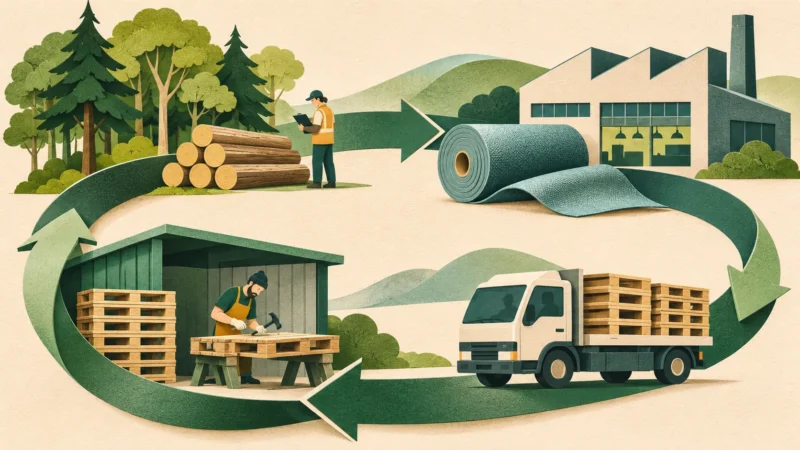
A reusable pallet has to come back. CHEP’s owner, Brambles, manages that return loop through a shared pool of pallets, crates, and containers. Its FY26 annual report states that the network covers roughly 352 million assets and more than 750 service centers. Collecting and repairing equipment lets it move through successive customer trips instead of getting scrapped after a single delivery.
In that report, Brambles estimates its share-and-reuse model helped customers avoid about 2.69 million metric tons of CO2 equivalent in FY26, based on its lifecycle comparisons with single-use alternatives. This represents a modeled benefit for customer supply chains, not a drop of the same size in Brambles’ own operational emissions. Both the baseline alternative and the number of trips shape the final result.
If your business is considering returnable packaging, test a route where collections are straightforward. Track completed trips, return mileage, repairs, and losses. Brambles’ FY26 report recorded a US$116.9 million provision expense for irrecoverable pooling equipment, a reminder that even a large network loses assets it can’t recover. Budget for missing containers before promising cost or carbon savings.
What should a sustainable supply chain actually improve?
Start with the specific harm or waste you want to cut. A dye house might need better wastewater treatment. A warehouse might toss out packaging that another site could reuse. A supplier may need to fix working hours or pay practices. Each problem demands its own evidence, and progress on one front doesn’t settle the others. These case studies help because they point to concrete work a buyer can investigate, instead of handing an entire company a blanket sustainability label.
Carbon accounting helps locate some of that work. The GHG Protocol’s Scope 3 standard outlines 15 categories of indirect emissions across the value chain, designed to help a company track its footprint over time. Comparing two companies takes extra care because their size, activities, and calculation methods differ. A percentage copied from one company’s report rarely makes a sensible target for another without that context.
For buyers, Scope 3 disclosure can expose impacts that never show up on an office electricity bill. Operational decisions still drive what actually changes. Extending an asset’s useful life through repair and reuse deserves a look before ordering a replacement. Ask how long the repaired item will last and what maintenance it requires.
Six checks before accepting a supplier’s sustainability claim
Keep the claim and its supporting evidence together in the purchasing file. A reviewer should be able to see what was checked without repeating the whole investigation. These six questions cover the core verification steps before you rely on a vendor figure:
What does the claim cover?
Name the product, facility, and supplier tier. A certificate for one mill doesn’t automatically cover another mill weaving the same fabric.
Which dates and businesses are included?
Record the reporting period and baseline. Check whether an acquisition, divestment, or updated calculation method skews the comparison.
Where did the data come from?
Separate measured figures, supplier estimates, and industry averages. Ask how site-wide data was allocated to the specific product you buy.
Has the result happened?
Keep completed reductions separate from proposed projects and long-term targets. Put a review date next to work still underway.
Did total impact fall?
Check total emissions alongside the intensity measure per unit or per dollar. Rising production can easily wipe out an efficiency gain.
What did the outside reviewer examine?
Read the assurance scope and any exclusions. Verification of operational emissions doesn’t automatically extend to upstream suppliers or product claims.
Certificates and ratings answer different questions too. A product declaration details specific environmental impacts under a defined calculation method, while a supplier rating scores management practices within its stated scope. Neither replaces direct evidence for a separate claim. If your purchase depends on recycled content, ask for the chain-of-custody records that prove it.
FAQ
Procurement teams frequently run into edge cases when auditing supplier sustainability disclosures, comparing local versus distant vendors, and working around missing upstream Scope 3 records. These answers address the most common verification questions buyers face during contract reviews.
Which companies provide useful sustainable supply chain examples?
Published reports from Patagonia, Inter IKEA Group, Schneider Electric, Walmart, Interface, Unilever, and Brambles offer documented examples. Their disclosures cover distinct practices, including supplier assessments, material shifts, sourcing controls, and reusable transport equipment. Focus on the individual practice and its supporting evidence when making a comparison; the company name alone tells you very little about a specific purchase.
How can a small business verify a supplier’s sustainability claim?
Request evidence for the exact product or site involved, then check its dates and scope. When a certificate has a public registry entry, match the holder and certificate number. If the supplier sends a group-wide report, ask which section backs the claim about your order. Log unresolved questions instead of treating a missing answer as a pass.
Is a local supply chain always more sustainable?
No. Distance is only one piece of the assessment. Compare how the product is made, the transport mode and load factor, and how long the item lasts. Local sourcing can make site visits or returns easier, though that convenience doesn’t guarantee a lower total environmental footprint.
What is the difference between a green and a sustainable supply chain?
The terms overlap. Green supply-chain work usually targets environmental impacts like energy use, waste, and pollution. Sustainable supply-chain work also covers people, including living wages, safety, and labor rights. Spell out your exact requirements in the contract instead of assuming either label carries a single agreed meaning.
Can supply-chain sustainability improve on a limited budget?
To improve supply-chain sustainability on a limited budget, start with avoidable waste or a recurring purchasing headache, and test a change before committing broadly. Using existing supplier records can cut down on new reporting work. Some upgrades will require upfront capital, so compare total costs over a realistic period instead of assuming a greener option will immediately cost less.
What if supplier emissions data is incomplete?
Use documented estimates where primary data is missing, and state the method, assumptions, and gaps clearly. Push for better primary data where it could change a purchasing decision or materially shift your inventory. Stick to the same calculation method when tracking progress, or explain and recalculate the baseline when the method changes.
Running a First Supplier Sustainability Pilot
Pick one purchase you understand well enough to change. Packaging used on a regular delivery route is much easier to investigate than hundreds of unrelated products at once. Record what you buy, how much gets damaged, and what happens after delivery. Put one person in charge of the pilot and agree on the exact result that would justify expanding it.
Before sending out a new questionnaire, ask what evidence your supplier already holds. They may have a current product declaration or material input logs that answer your question right away. Agree on the missing details and set a realistic date to provide them. Working with suppliers on circular systems also means settling who collects returned items and who pays when equipment gets damaged.
Measure a proposed change against your current process over several normal order cycles. For reusable or alternative packaging, factor in the purchase price, storage space, return transport, and replacement costs. Count damaged goods too, since a lighter pack that leads to more broken products is a poor trade. Write down what the pilot proved and what remains uncertain before changing the rest of your orders.