



What is The Sharing Economy? The Sharing Economy is a fairly new concept in the global economy which compromises the sharing of goods, labour and services between consumers and workers. The most familiar sharing economy start-ups you may have heard of include Uber, Airbnb and TaskRabbit.
In 2010 The term ‘Collaborative Consumption’ was coined when Rachel Botsman, author of What’s Mine Is Yours: The Rise of Collaborative Consumption, began popularising the ideas of these start-ups and by 2011, the phrase gave way to the more user-friendly term ‘sharing economy’. In 2011, Time Magazine published an article which hailed the sharing economy as one of the ‘Top 10 Ideas That Will Change the World’.
The RSA Fair Share Report, published 13th January 2016, “guides readers through the recent evolution of the sector [the sharing economy], focusing in particular on the meteoric rise of some online platforms [such as the fast growth of start-ups such as Uber] and what this means for us all”.
The Report also aims to “make the case for a new process of ‘shared regulation’ as the starting point for realising the sharing economy’s radically transformative potential for the common good”.
The Report, is separated under 5 headings: Rethinking the Shared Economy – The rise of mainstream sharing, Making sense of ‘disruption’ – Disruptive innovation, The Politics of sharing – Controversies over regulation, Value added, value lost: Exploring trade-offs and Concluding Remarks.
Rethinking the Shared Economy – The rise of mainstream sharing:
- There are 80 million sharers in the US and 23 million shares in the UK and usage of platforms overall in the sharing economy grew in America by 25% in 2015 – at least 1/5 people now choose sharing as their preferred option
- The Media’s ‘love affair’ has ‘gone cold’ as commentators and journalists have attacked the usage over the past year. The Guardian declared that the term “needs to die” because sharing has become renting while The New York Times published an article suggesting words are being twisted to make sharing apps seem selfless.
- “The Sharing Economy is used to describe more than exchange; it refers to a ‘socio-economic system”
- Benita Matofska, founder of The People Who Share, a global campaign promoting the sharing economy, describes how “When we share access to our human and physical resource directly with one another we are reflecting a cultural shift in how we want to live and work, reclaiming power from the institutions and corporations that typically mediate exchange.”
- Neil Gorenflo, co-founder of Shareable, believes that initiatives such a ‘tool libraries’ and ‘timebanks’ embody the sharing economy.
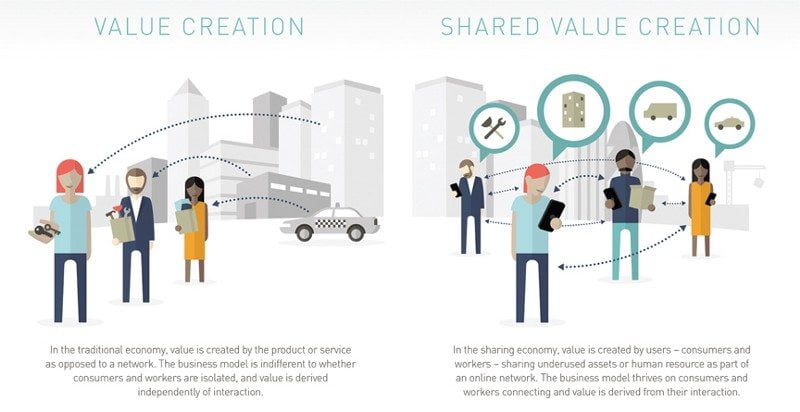
- The ‘Network effect’ is highlighted as being a key factor in the success of sharing economy start-ups. The Network effect is often observed in social media platforms wherein each new user of a network “increases the usefulness of the network” for other users as well as it’s overall value. “It is the users, both consumers and workers, of these online platforms that share the charge of creating value”
This informative back-drop of the grassroots of the sharing economy allows for thorough understanding of how, when and why it all started and how it has grown since then. Understanding and acknowledging the successes of start-ups like Uber means that consumers and workers can see the benefits and efficiency of contributing to a sharing economy where convenience and sustainability take high priority.

Making sense of ‘disruption’ – Disruptive innovation:
- Clayton Christensen, a professor at Harvard Business School, developed the theory of ‘disruptive innovation’ in the mid-1990s. Examples of this date back to Theodore Vail’s breakdown of the telegraph via the telephone and recent, modern disruptive innovations include CDs being replaced by Apple iTunes and DVDs being replaced by Netflix and other video streaming sites.
- Uber is a chief example of a sharing platform dubbed as a ‘disruptor’ by the media. However, the report describes how “However, Uber and other sharing platforms like it do not fit the model of ‘disruptive innovators’.” As Uber never targeted customers in the lower tiers of the market which Christensen’s theory dictates is a key feature of a disruptive innovator. “Uber would actually be considered a ‘sustaining innovator'”.
- Reid Hoffman, co-founder of LinkedIn, says that “First-scaler advantage beats first-mover advantage” he explains that ” Once a scale-up occupies the high ground in its ecosystem, the networks around it recognise its leadership, and talent and capital flood in”
Addressing the concept of disruptive innovation is important in considering the possible advantages and disadvantages of the sharing economy. While some consider sharing start-ups as being more efficient and convenient, others consider it a hindrance to established competitors in traditional industries. This section of the report allows understanding of the possibility of disruption of the traditional economic climate.
The Politics of sharing – Controversies over regulation:
- Rt Hon Matthew Hancock MP launched an independent review declaring that “There’s huge economic potential for the sharing economy and I want to make sure that the UK is front and centre of that, competing with San Francisco to be the home of these young tech start-ups”
- PwC estimates that the sharing economy’s current global revenues of £9bn [in 2014] could reach £230bn by 2025. Furthermore, by 2025 the sharing economy would reach 50% market share in key sectors such as holiday accommodation and ridesharing/car rental.
- However, there is discussion on how the sharing economy should be regulated by governments.
- Documents from the Human Environment and Transport Inspectorate in Amsterdam described Uber as a possible “criminal organisation” while London has fully embraced the innovation and means that the city is now home to one of Uber’s fastest growing markets.
- Across the globe discussions are taking place. In the US, Hilary Clinton describes the ‘on-demand’ or ‘gig economy’ as creating “exciting opportunities” but also “raising hard questions about workplace protections and what a good job will look like in future”
- The Growth of the sharing economy globally is outpacing our legal and political institutions -As more decentralised sharing platforms emerge governments will find it more challenging to regulate.
- ‘Shared regulation’ entails the redistribution of regulatory responsibility to parties other than government.
- Widening participation in ‘self-regulation’ would see better results in remedying some issues in the sharing economy,
- Shared regulation could enable the integration of decentralised platforms in mainstream markets
This section of the report considers the issues of the political landscape surrounding the sharing economy. Regulating the sharing economy could prove to be difficult and there are global discussions as to the best route possible for regulating a fair and efficient economic climate in light of the rapid-growth of the sharing economy,
Value added, value lost: Exploring trade-offs:
- For consumers, sustaining innovation has led to greater accessibility of goods and services that previously were expensive and/or entailed the costs of private ownership. However, there are downsides as the quality of products or services are not necessarily on par with established and leading competitors.
- For workers, the barriers for entering the sharing economy are either high or low. For example, the barriers to entry to be an Airbnb host are high and insurmountable for many while selling craft products on Etsy face no additional barriers to those who are traditional skilled craft workers. If we want a highly productive economy gig workers cannot stagnate in low-wage, insecure employment without development opportunities.
- For communities, there is greater trust between strangers. However, there is a difference between trust and honesty and a high rating is not necessarily indicative of whether you can trust someone – the subjectivity of ratings and review systems has material and possibly emotional consequences for some and there is a risk that social injustices perpetuated offline will be reproduced in online communities.
- For the state, realising benefits such as tax revenue, has been difficult given that the economic activity is challenging to monitor and regulate. The state will continue to have an important role, but it is clear it must adapt to the changes occurring in the social and economic landscape.
- For the economy, there is enormous potential here for more new business models to emerge. While there will undoubtedly be more online platforms for sharing resources in new, more efficient ways, some corporates will adapt features of these platforms.
- For the environment, the sharing economy tends to promote access to underused assets, which is a way of prolonging the lifecycle of products and materials while also undermining the need for private ownership.
This section highlights the pro’s and con’s on various different society values; acknowledging the impact upon consumers, workers, communities, the state, the economy and the environment to assess the overall benefits of the sharing economy,.
In the Concluding remarks of the Report, The RSA describe how as climate and demographic changes alter the world we live, there will a stronger social and environmental imperative to regulate differently than if the only stake in the ground was economic. It also suggests that we are at a crucial juncture in terms of influencing the future of sharing platforms.
The Report is a go-to resource for understanding the benefits and impact the sharing economy could have on our fast-growing global climate. There is plenty of potential for new business models to emerge but more importantly a sustainable and fair way of life that many could benefit from. With that, comes issues of regulation, just as governments have struggled to keep up with the rapid development of the internet and the social and moral issues emerging from the use of online platforms, the RSA is suggesting an alternative route of regulation could be the most efficient way forward.
To read the full report, click here