10 Recycling Business Ideas to Test Before You Invest

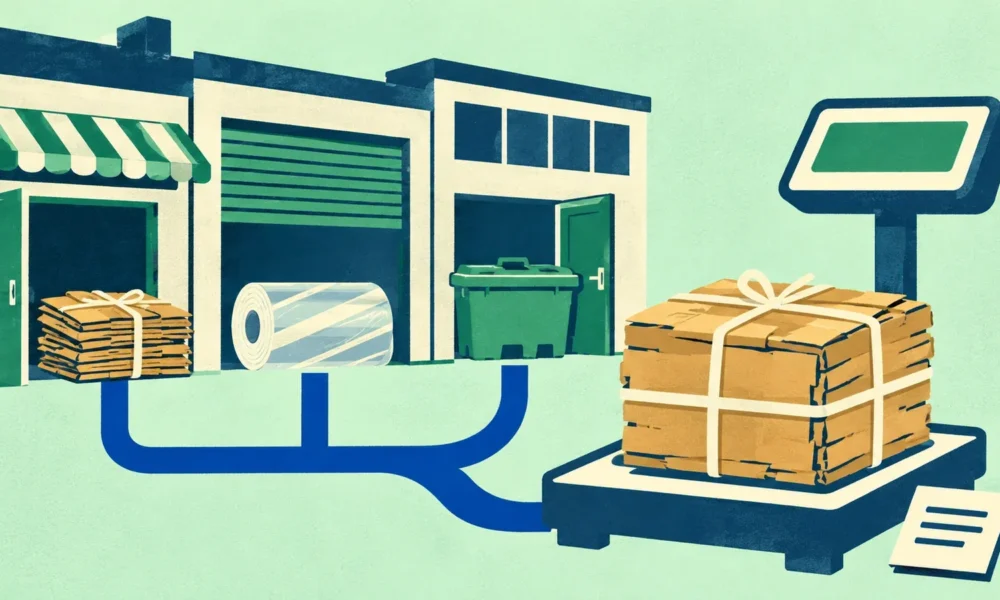
Start with one material, a few nearby customers and a processor that will accept your trial load. Get the processor’s grade, minimum volume, fees and rejection terms in writing. Quote a paid pickup, then track the full trip from the first stop to unloading. Use those figures to see whether the route can cover its costs when scrap prices fall.
Cardboard blocks a shop’s stockroom. A flooring contractor needs yesterday’s carpet off the site. An office manager has retired laptops in a cupboard, with no record of what’s on them.
The ten ideas below cover commercial collection and specialist handling. The regulatory examples are from the United States.
- Start with an outlet. Ask the processor to approve a real sample and tell you what happens to a rejected load.
- Price the whole trip. Include loading, the drive to the facility and the time to unload. Work out when the customer pays and when your fuel and wage bills fall due.
- Choose a first stream your team can handle. Cardboard and clean wrap depend on grading and volume. Electronics, solar panels and other specialist streams bring additional duties that can change the cost of collection.
10 recycling business ideas and who could pay for them
| Business idea | Potential customer | Possible revenue (illustrative) | What to establish first |
|---|---|---|---|
| Retail cardboard pickup | Independent shops and small fulfilment sites | Collection fees; agreed cardboard proceeds | A local outlet that accepts your load size |
| Warehouse stretch-film collection | Warehouses and distributors | Service fees; specified film sales | The buyer’s exact film grade and preparation rules |
| Small-business IT equipment collection | Offices and managed IT providers | Collection and documentation fees; conditional resale share | Secure custody and a qualified receiving partner |
| Solar-panel collection logistics | Installers and maintenance contractors | Project collection and handling fees | Waste classification, lawful transport and recycler acceptance |
| Carpet take-back logistics | Flooring installers and refurbishment contractors | Scheduled collection fees | A processor accepting the carpet types involved |
| Commercial linen recovery | Hotels and commercial laundries | Collection fees; reuse or specified fibre sales | Separate outlets for each condition and fabric grade |
| Used cooking-oil collection | Restaurants within a compact area | Processor payments or agreed service charges | Ownership, oil quality and registration requirements |
| Food-scrap collection | Cafés, shops and workplaces | Recurring collection fees | Processing charges and contamination rules |
| Trade metal-offcut collection | Fabricators and other workshops | Graded scrap sales; agreed pickup charges | Material ownership, grades and safe loading |
| Event can-recovery service | Venues and event organisers | Event-service fees; eligible material proceeds | A collection agreement and workable staffing plan |
Ask whether the receiving facility pays for the material, takes it free of charge, or charges a processing fee.
1. Cardboard pickup for independent retailers
Offer scheduled cardboard collection to nearby shops that lack space for a large bin or baler. A tight route can serve several small customers on a single trip, provided their existing waste contracts and local collection rules allow it.
Walk the route before pricing it. Find out when deliveries arrive, where staff stack the boxes, and whether you can load up without waiting for someone to open a back door. Collection time varies far more than the volume of cardboard suggests. If clean boxes have a confirmed second-use buyer, keep that reuse stream separate from cardboard headed for pulping.
A paper packer or aggregator may take loose cardboard in loads too small for a paper mill. The ReMA material specifications give you a common grading language. Ask the receiving site what it accepts, including moisture limits and how it wants the cardboard prepared. Time the stops before assuming a baler will save you money.
2. Clean stretch-film collection from warehouses
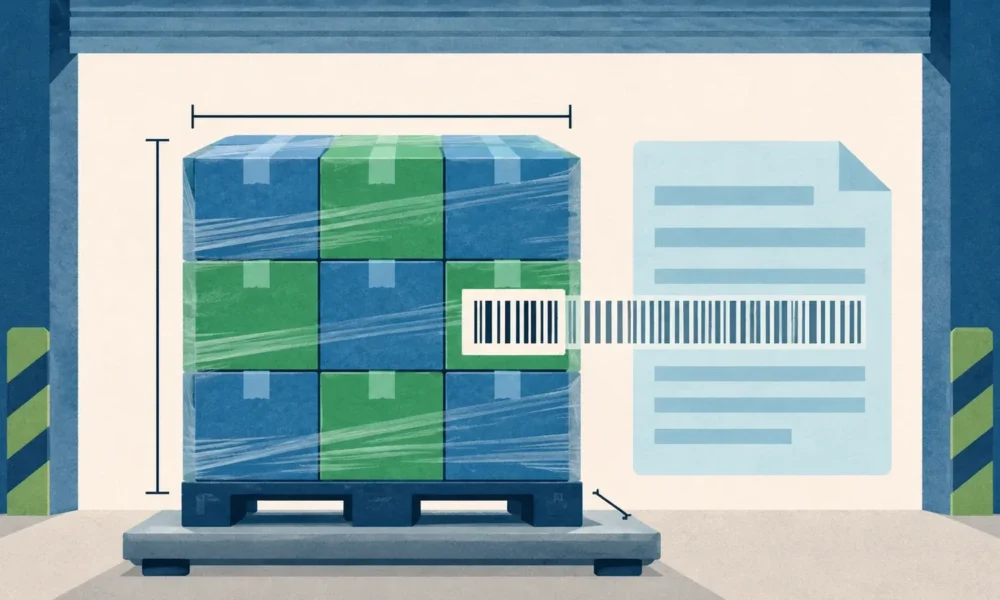
Collect pallet wrap separately from other warehouse plastics. The service depends on keeping film that a buyer accepts clean from the moment a worker strips it off the pallet.
Set the collection point right where workers strip the wrap. Ask the receiving facility about labels, tape, strapping, and coloured film before you train the warehouse staff. Mixing several packaging types together and sorting them later will quickly eat the margin on the load.
Napa Recycling’s stretch-wrap guidance directs clean, clear commercial film to the Napa Recycling & Composting Facility and keeps it out of curbside carts. The APR model bale specifications describe grades a buyer may use. Ask your own receiving facility to approve a sample and confirm drop-off terms before you collect a load.
3. Documented IT equipment collection for small businesses
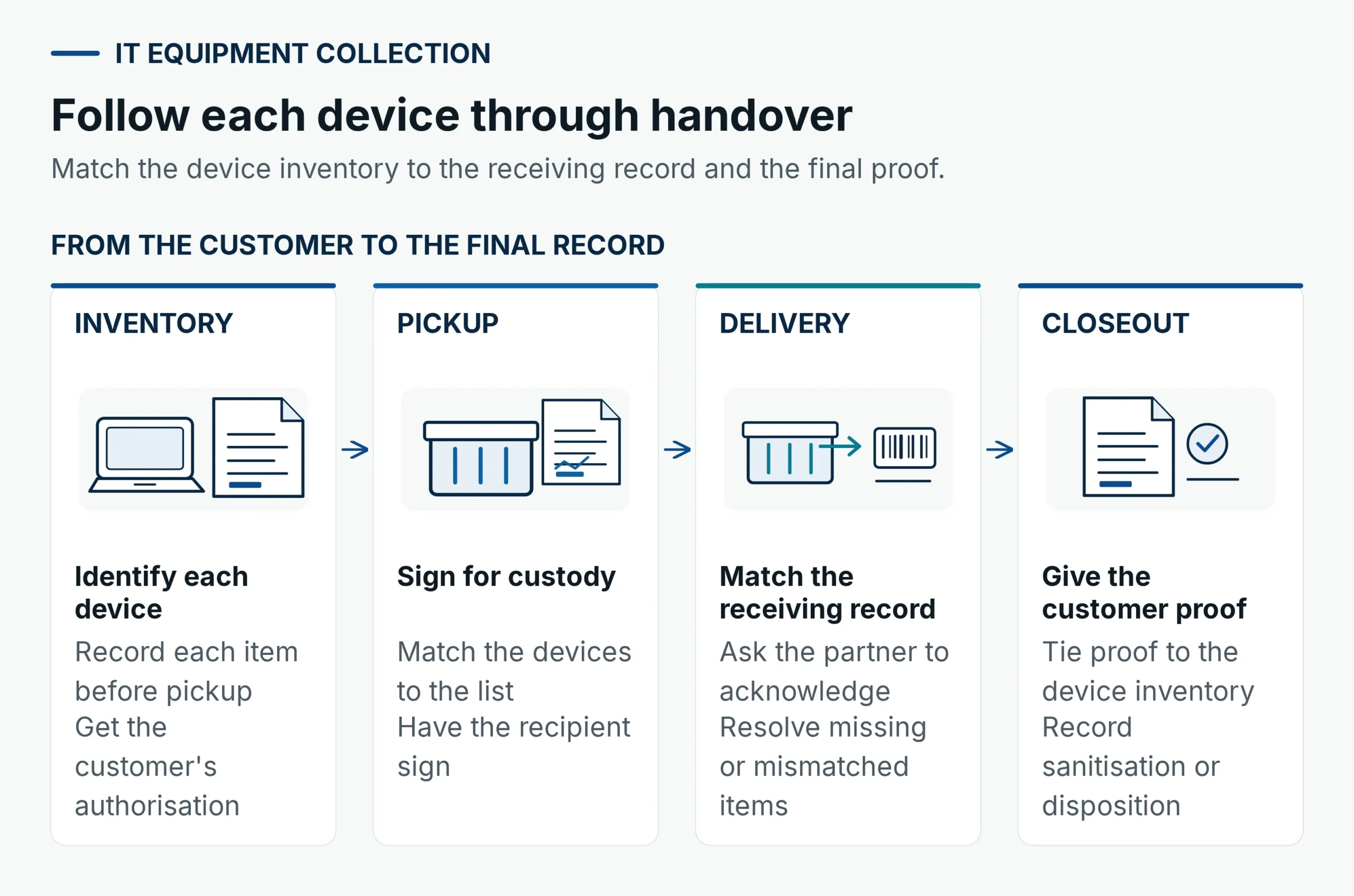
Give small firms a scheduled way to retire computers. Record each device and document its handover to a reuse or recycling partner. Charge for collection and documentation. Include resale income in the budget only if the partner has agreed in writing how it tests and values devices and how you share the proceeds.
Local IT support companies know when businesses are replacing their hardware. Get the customer’s authorisation and agree who removes devices from management systems, who sanitises the storage media, and what proof the customer gets. Keep the asset list with each handover.
We are seeing data-sensitive organizations hold onto end-of-life devices for longer because of concerns around data security and chain of custody.
Aiden Neary, founder and CEO of Xscindo, in Resource Recycling
Use NIST SP 800-88 Revision 2, published in September 2025, to specify how your partner will sanitise media and verify the result. EPA’s recycler guidance describes R2 and e-Stewards, both independent certification programs. Confirm which facility and services the certificate covers. Check PHMSA’s transport guidance for lithium batteries and agree with your carrier how it will accept damaged devices.
At pickup, match each device to the inventory and have the person taking custody sign for the items. Ask the receiving partner to acknowledge the same devices at delivery. Send the customer proof of sanitisation or the agreed disposition, tied to the inventory, and resolve any missing or mismatched items.
4. Solar-panel collection for installers
Installers and maintenance contractors may pay you to arrange the collection and delivery of retired panels. Price the handling, transport and recycler’s fees before estimating any material value.
Start with panels that qualified personnel have removed and made safe. Ask the recycler what it accepts and how it wants broken modules packaged. Confirm the generator’s waste classification and the applicable transport and storage rules before you take possession. A collection broker can arrange a qualified carrier where its own permissions allow.
On a storm cleanup, Green Clean Solar had to coordinate unloading with the hauler and recycler. At RecycleForce, Andrew King said his team arranged destinations for recovered material before taking panels in.
We did not take panels until we were 100 percent sure where all the material could go.
Andrew King, director of inventory and quality control at RecycleForce, in Waste360
EPA’s current solar-panel FAQ says solar panels are outside the federal universal waste program, while some states have added panels to their own programs. Check the rules at the origin and destination and in any state you travel through.
According to the EPA’s explanation of panel recycling, glass accounts for about 75% of a crystalline-silicon panel’s weight. Its cells contain small amounts of valuable metals such as silver. Ask for a written processing quote by panel type before accepting a batch.
5. Carpet take-back for flooring contractors
Collect old carpet from flooring jobs and haul accepted material to a specialist processor. An installer often values a reliable removal slot far more than a promise that the old carpet holds resale value. Schedule collections around their work hours and keep the load out of mixed demolition waste.
Ask the processor which fibres and backing it accepts and how it treats wet or contaminated pieces. Confirm where it wants carpet tiles separated from rolled carpet. Run one trial with an installer and log how long rolling, loading and unloading take.
In its September 2026 update, Carpet America Recovery Effort reported 19.1 million pounds of gross collections and 16.8 million pounds of recycled output in its California program in the second quarter of 2026. Confirm what your own outlet will take and whether you qualify for any stewardship payments before quoting regular pickups.
There’s very little demand for our materials in the marketplace today, and there are huge uncertainties in the global economy impacting all recycling centers.
Bob Peoples, CEO and executive director of Carpet America Recovery Effort, in a September 2026 interview with Resource Recycling
6. Linen recovery for hotels and commercial laundries
Build a pickup service around identifiable batches of retired sheets, towels, or uniforms, setting up separate destinations for usable items and material accepted for recycling. A repeat commercial source lets you check fabric composition and condition before you collect.
Ask a laundry or hotel to set aside one representative batch. Sort and weigh it with prospective buyers’ specifications in hand. A buyer taking clean cotton wiping rags may have zero use for a synthetic blend, while a reuse buyer might reject items stamped with permanent branding. Factor sorting labour and reject disposal right into your quote.
Log how much linen goes to reuse and how much goes to fibre recovery. A sheet sold for use again belongs in the reuse total. The same distinction matters when choosing between repairing versus recycling.
7. Used cooking-oil collection on a restaurant route
Collect used fryer oil from a tight cluster of restaurants under an agreement with a renderer or processor. Commercial terms might involve a rebate to the restaurant, a collection charge, or another split. Find out what setup the kitchen already has before quoting a price.
Ask the processor how it measures water and food solids, which minimum volume it accepts, and what quality deductions it takes. Set collection terms specifically for used fryer oil. Confirm access to each container and keep grease-trap waste separate.
California’s Rendering Program regulates inedible kitchen-grease transporters. Whether federal Spill Prevention, Control and Countermeasure rules apply depends in part on the type of facility, its storage capacity and whether a discharge to covered waters or adjoining shorelines can reasonably be expected. Include container servicing and the drive to the processor in your quote.
8. Food-scrap collection for small commercial sites
Sell recurring food-scrap pickups to businesses close enough to serve efficiently. Clean containers, reliable pickups, and washing arrangements form the core product. Build the receiving facility’s processing fee into your budget unless a written agreement says otherwise.
The Associated Press reported in October 2026 that more than 70 homes and businesses had signed up for weekly pickups from Detroit’s Scrap Soils. It’s a composting nonprofit. The sign-ups show local interest in the weekly service. The report gives no cost or margin figures. Lou Hammer, executive chef at The Grand Porter, described fitting the pickup into the kitchen’s usual bagging routine.
In a separate pilot in Avondale Estates, Georgia, CompostNow staff sorted out non-compostable items the collection crews brought back.
At this facility, the material has to get sorted through for contamination.
David Paull, chief impact officer at CompostNow, in WABE’s report on the Avondale Estates pilot
Give each customer the receiving facility’s list. Ask separately about bin liners and packaging labelled compostable. Track contamination by site during the pilot and show staff what needs to come out.
9. Sorted metal-offcut collection from workshops
Arrange pickups of identified metal grades from fabricators and workshops. Confirm who owns the offcuts and ask the receiving yard to price a sample. Mixed shop clear-outs take longer to sort and can bring a lower price.
Ask shops to separate grades if the higher price covers the extra handling. Coatings, fasteners and other contamination can change what a yard pays for a load.
Record who supplied the metal and check local scrap-dealer rules. If you expand into refrigerators or air conditioners, review the EPA refrigerant-disposal requirements with the final recycler. Agree in advance who handles recovery and who supplies any required proof.
10. Can-recovery services for events and venues
Offer to separate and haul away cans during and after an event. Charge for the crew and pickup, and put any material proceeds or deposit refunds in the contract. Work out how much staff time a late-night teardown adds.
Build a trial around a single event. Agree on bin placement, who empties them, where full bags wait, and when your truck can load. Time how long your crew spends pulling out cups, food, and other trash. If sorting takes longer than the pickup itself, adjust the bin placement or staffing before booking a full season.
Check material ownership with the venue and its waste hauler. Confirm how the buyer wants the cans prepared. Under Michigan’s deposit guidance, you can claim Michigan’s deposit only on containers that carried a Michigan deposit. Report accepted weight and rejected material separately to the venue.
How to check whether a recycling route can make money
Calculate what remains from a complete run after the direct costs. Count the drive to the receiving site, time spent unloading, and any fee for rejected material. A round of pickups can look profitable before you add the final delivery leg.
Contribution per run = pickup fees + material sale proceeds − payments to suppliers − direct labour, vehicle, handling, processing and reject costs.
Here’s a worked example in US dollars. It uses one four-hour run, including delivery, and assumes you pay nothing for the material at pickup.
| Per-run item | Example amount |
|---|---|
| Pickup fees | +$240 |
| Material sale | +$60 |
| Driver labour, four hours at $25 | −$100 |
| Variable vehicle costs | −$60 |
| Handling and processing charges | −$40 |
| Contribution before fixed costs | $100 |
If the material sells for $30, the same run contributes $70. At that lower sale price, one extra hour of driver time at $25 brings the contribution down to $45.
At $100 per run, 20 runs cover $2,000 in monthly fixed costs. At $70 per run you need 29 runs. At $45 you need 45, assuming the same contribution on every run and no change in overhead. Check whether those runs fit your driver’s schedule and the processor’s opening hours.
What will the pilot cost?
Separate the setup costs you pay once from the bills you’ll carry each month. Get local quotes for permits, insurance, bins, vehicle hire and any permitted storage space before promising service. Include your own time if the driver line leaves it out. Plan for the cash you need while customers’ first invoices are still outstanding.
Before buying equipment, compare a small route that delivers directly to a processor with a route that needs its own storage or sorting. The second route brings property and insurance costs even when it runs below capacity. Put those costs beside your actual pilot figures and use the same number of collection days for both.
Find an outlet before buying recycling equipment
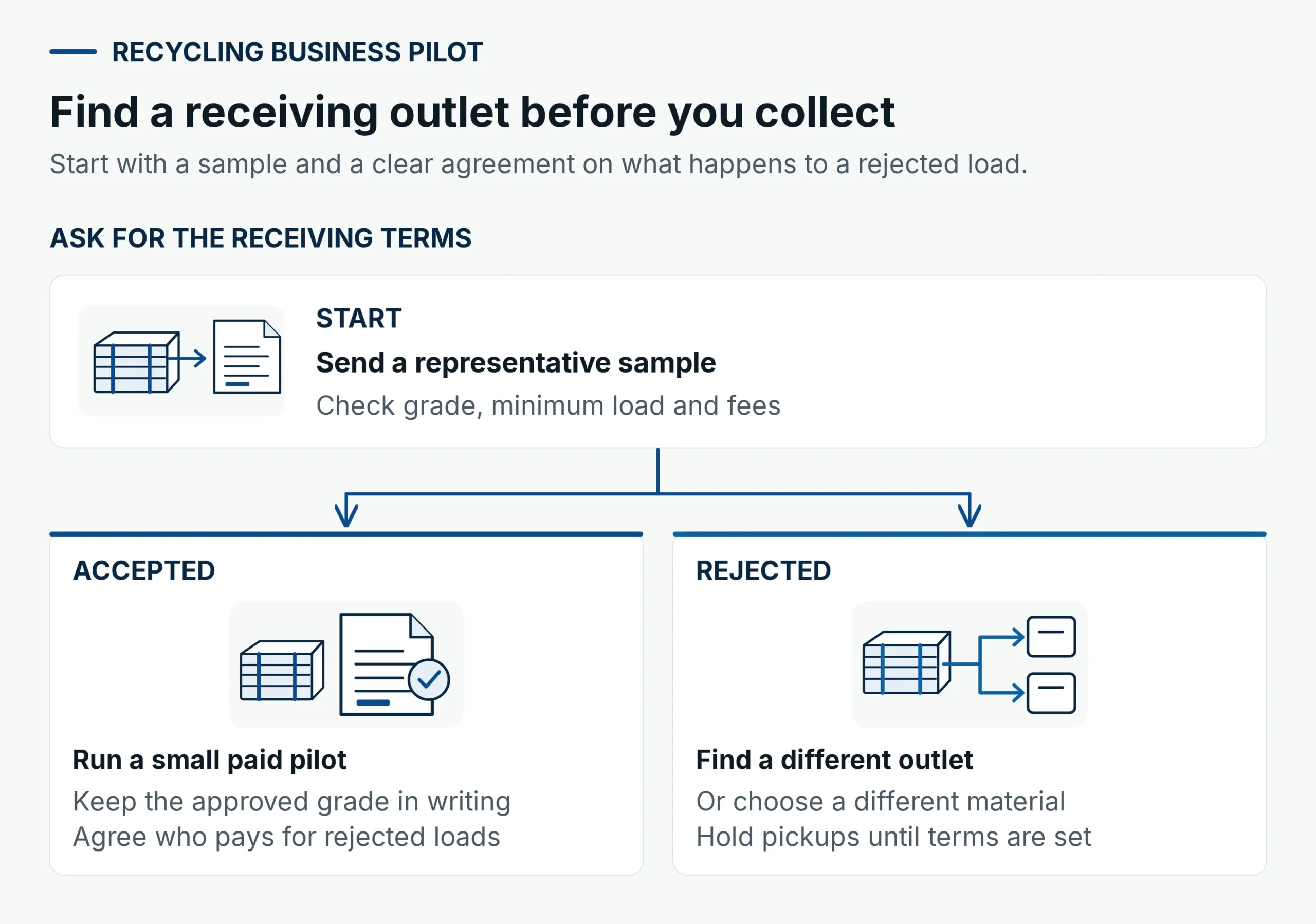
A buyer’s written acceptance terms beat a vague assurance that a yard “takes recycling.” Ask an actual receiving facility to review your proposed stream and inspect a sample. A broker can help, though you still need to know where the material goes and what happens if that site stops taking it.
- Grade and preparation. What materials, attachments, moisture levels, and contaminants are acceptable under the buyer’s rules? Does the load need to arrive loose, bagged, or baled?
- Volume and delivery. What are the minimum load size, booking procedure, and unloading method? Can a local aggregator take your early, smaller test loads?
- Price and deductions. How is pricing set, when does it change, and who pays for testing, sorting, or rejected weight?
- Transport responsibilities. Who books and pays for freight, when does ownership or risk transfer, and who handles a refused load? Put those responsibilities in the agreement.
- Payment and records. When does payment arrive, which scale ticket controls settlement, and how do you resolve weight disputes?
- Fallback destination. Where will you divert loads during a plant closure, equipment breakdown, or sudden shift in the buyer’s specs?
To find plastics outlets, try the APR buyers and sellers directory. Call each facility to confirm it still takes your grade and can accept your expected load size.
Before signing a lease or promising recurring pickups, send the receiving facility a sample and get written terms for the grade, minimum load, fees and rejection costs. If the processor cannot accept your load, confirm another permitted outlet or change the material you plan to collect before signing customers. Pilot a small route once an outlet has confirmed the terms.
Check the site and collection rules before accepting material
Describe your exact operation when talking to the local planning office, waste regulator, and fire marshal. Calling yourself a “recycling business” could mean brokering pickups from a laptop, parking a loaded box truck overnight, or running a noisy sorting line. Each activity triggers different rules.
Check whether an exclusive municipal hauling agreement covers the customer and whether temporary storage or transfer needs its own permit. Georgia, for instance, requires a collection permit-by-rule for businesses collecting food scraps for composting when they combine material from different sources or pick up from multiple locations in a day.
Before signing a lease, check permitted uses, truck access, storage limits, floor drainage and applicable fire codes. Show the fire marshal the materials and layout you’re proposing. Get an insurance quote for the work you’ll actually do, especially if it involves data-bearing electronics, cooking oil or lithium batteries.
The EPA’s composting guidance describes several methods and operating scales. If you plan to compost food scraps yourself, give the state regulator your material types, volumes and proposed method before you choose a site. Check the approvals for hauling and for processing separately.
Frequently asked questions about starting a recycling business
Can I run a recycling business from home?
Check local zoning, lease or homeowners’ association rules, and insurance before you dispatch from home or park a loaded truck there. Ask separately about storage and sorting. A route that goes straight from the customer to the receiving facility avoids running a storage yard.
Do I need certification to collect recyclables?
Check the permits your regulator requires for the materials you plan to collect. A commercial customer may also ask for a particular certification in its contract. Verify which company, site and services each certification covers.
Can I run a recycling pilot with a rented vehicle?
Check that the rental contract allows commercial hauling and the material you plan to carry. Confirm the vehicle’s payload, business-use insurance, and any applicable carrier and waste-collection permissions. Compare the full rental cost, including mileage and loading time, with what the pilot is likely to earn.
Who pays if a recycling processor rejects my load?
The agreements with the customer and processor determine who pays for a rejected load. Specify who covers inspection, re-sorting, return transport, or lawful redirection. Ask for the rejection reason and weight in writing, then tell the customer what needs to change before the next pickup.
Test one stream before adding another
Run the same route for several pickup cycles before committing to another material. Get the required permissions and the receiving partner’s written agreement before the first run. For each cycle, compare the expected and accepted weight. Write down where the difference came from and who bore the cost.
- Pick a single material stream and a tight cluster of prospective customers. Log their real volumes and pickup habits instead of guessing from the square footage of their building.
- Set up a trial with the receiving facility and put your collection scope, pricing, and exclusions in writing for the customers.
- Track every run: stop times, mileage, gross weight, accepted net weight, fees, and payment dates. Log the reason for each rejection and bring it back to the customer.
- Review several normal collection cycles. Use the figures to revise prices or route timing, and address repeat rejections before adding accounts.
Buy equipment when the pilot shows what it saves. If daily loading is slow, compare the cost of owning a baler with the hours it would save and what a receiving partner charges to bale for you.
How we put this together

Amy McConaghy's five Blue & Green Tomorrow articles (2019 to 2023) examined smart thermostats, home energy monitors, green investing, and sustainable healthcare services.
- Published
- Sources
- Primary reporting
Keep moving along the spectrum
The same desk, then neighbouring desks along the brand spectrum.