Space junk: the abuse of the abyss

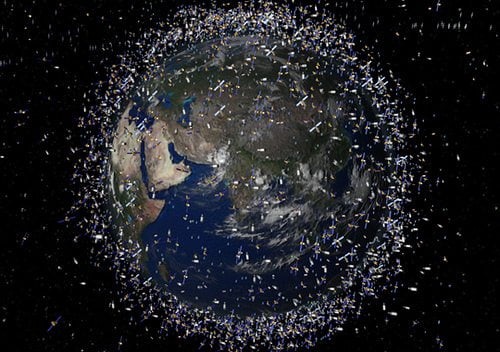
When we talk about pollution, we naturally do not think further than our own planetary boundaries. But mankind is not only polluting the Earth’s atmosphere, but also the space around it.
It is estimated that there are 29,000 objects 10cm or larger orbiting the Earth. That number is constantly rising and only 7% of these are working satellites.
The rest is debris, uncontrolled and lost in space, made up of everything from ‘dead’ satellites and used rocket boosters to spatulas and gloves.
Increasing the amount of waste in space is not sustainable. As orbits become congested, it is feared that space debris will represent an increasing threat to our immensely valuable satellite infrastructure.
There are approximately 1,000 active satellites in orbit today. They provide services we now see as essential, such as communication, television and navigation. It is estimated that to replace all of them would cost around €100 billion. The financial impact on the global economy of losing these satellites would be even higher.
There has already been four major collisions in low Earth orbit. The most serious was in 2009, when an Iridium Communications satellite collided with a defunct Russian Space Forces satellite at over 25,000 miles per hour.
Meanwhile in April last year, a $690m NASA telescope only narrowly avoided a collision with another dead Russian satellite when NASA engineers pulled off an emergency evasive manoeuver.
Heiner Klinkrad, head of the European Space Agency’s (ESA) space debris office, said in April, “Our understanding of the growing space debris problem can be compared with our understanding of the need to address Earth’s changing climate some 20 years ago.
“While measures against further debris creation and actively deorbiting defunct satellites are technically demanding and potentially costly, there is no alternative to protect space as a valuable resource for our critical satellite infrastructure.
“Their direct costs and the costs of losing them will by far exceed the cost of remedial activities.”
Experts at sixth European Conference on Space Debris concluded that future space missions must be sustainable, meaning debris has to be safely disposed of.
However, even if this were achieved, simulations have shown that the number of objects in orbit would continue to increase as debris continues to collide, generating more debris in a self-sustaining cycle.
The 2009 collision, for example, is believed to have created around 1,000 pieces of debris larger than 10cm in diameter.
Because of this, the ESA is hoping to develop technologies to actively remove large objects from low Earth orbit.
In July, the catchily titled UN Group of Governmental Experts on Transparency and Confidence-Building Measures in Outer Space Activities made a “landmark consensus”, agreeing in principle a series of steps to achieve sustainability in space.
However, Frank Rose, US deputy assistant secretary of state for space and defence policy, said the consensus is encouraging but there is still much to be done, Space News reports.
“We’re at the very early stages,” he claimed. “Bilaterally, are we where we need to be? I think the answer is no.”
Further reading:
How we put this together

- Published
- 9 Aug 2013
- Last updated
- 9 Aug 2013
- Sources
- Primary reporting
- Standards
- About
Keep moving along the spectrum
The same desk, then neighbouring desks along the brand spectrum.





