How does climate change affect the strength and frequency of floods, droughts, hurricanes, and tornadoes?

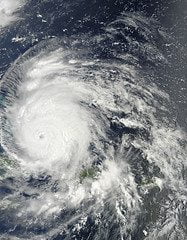
Climate change will have substantial impact on the frequency of extreme weather events, from droughts to floods, according to the Royal Society.
How does climate change affect the strength and frequency of floods, droughts, hurricanes, and tornadoes?
Earth’s lower atmosphere is becoming warmer and moister as a result of human-emitted greenhouse gases. This gives the potential for more energy for storms and certain severe weather events. Consistent with theoretical expectations, heavy rainfall and snowfall events (which increase the risk of flooding) and heatwaves are generally becoming more frequent. Trends in extreme rainfall vary from region to region: the most pronounced changes are evident in North America and parts of Europe, especially in winter.
Attributing extreme weather events to climate change is challenging because these events are by definition rare and therefore hard to evaluate reliably, and are affected by patterns of natural climate variability. For instance, the biggest cause of droughts and floods around the world is the shifting of climate patterns between El Niño and La Niña events. On land, El Niño events favour drought in many tropical and subtropical areas, while La Niña events promote wetter conditions in many places, as has happened in recent years. These short-term and regional variations are expected to become more extreme in a warming climate.
There is considerable uncertainty about how hurricanes are changing because of the large natural variability and the incomplete observational record. The impact of climate change on hurricane frequency remains a subject of ongoing studies. While changes in hurricane frequency remain uncertain, basic physical understanding and model results suggest that the strongest hurricanes (when they occur) are likely to become more intense and possibly larger in a warmer, moister atmosphere over the oceans. This is supported by available observational evidence in the North Atlantic. Some conditions favourable for strong thunderstorms that spawn tornadoes are expected to increase with warming, but uncertainty exists in other factors that affect tornado formation, such as changes in the vertical and horizontal variations of winds.
For more information from the Royal Society’s guide click here.
Photo: NASA Goddard Space Flight Center via Flickr

How we put this together

- Published
- Sources
- Primary reporting
- Standards
- About
Keep moving along the spectrum
The same desk, then neighbouring desks along the brand spectrum.





