


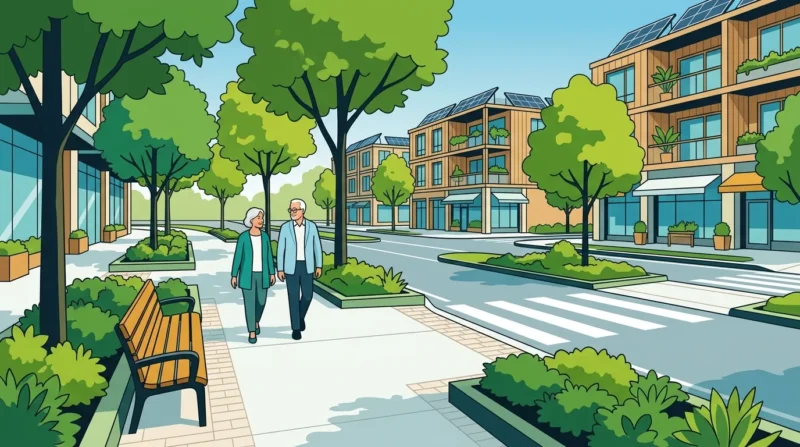
Walkable neighborhoods help older adults stay active and advance sustainable urban growth by placing everyday shops, parks, and transit within a 10 to 15 minute walk along level sidewalks, safely timed crossings, and shaded resting benches, replacing short car trips with low-carbon daily movement.
- Health agencies recommend 150 to 300 minutes of weekly moderate movement for adults aged 65 and older, plus balance and strength work on three or more days.
- Walking with an everyday purpose, such as collecting groceries or meeting a friend in the park, is easier to keep up than an unscheduled fitness loop.
- Older-adult street upgrades also advance sustainable growth by cutting short car trips, cooling paved blocks with tree canopy, and keeping local shops busy.
- Federal US traffic guidance sets a baseline pedestrian speed of 3.5 feet per second and highlights 3.0 feet per second where older walkers frequently cross.
Activity Starts Right Outside the Door
Staying active as we grow older can start right outside the front door when neighborhood streets make daily walking safe, level, and practical. Most people picture a long car ride to a distant gym, a membership contract, and special workout clothes before they even step onto a pavement.
For older adults, the quality of the route counts just as much as total distance. Smooth stone or paving, enough crossing time at busy junctions, and a bench on the way home turn a daunting outing into a steady habit.
Key takeaways
- Health agencies recommend 150 to 300 minutes of weekly moderate movement for adults aged 65 and older, plus balance and strength work on three or more days.
- Walking with an everyday purpose, such as collecting groceries or meeting a friend in the park, is easier to keep up than an unscheduled fitness loop.
- Older-adult street upgrades also advance sustainable growth by cutting short car trips, cooling paved blocks with tree canopy, and keeping local shops busy.
- Federal US traffic guidance sets a baseline pedestrian speed of 3.5 feet per second and highlights 3.0 feet per second where older walkers frequently cross.
Why Everyday Movement and Sustainable Growth Align
Everyday movement increases when short neighborhood trips feel safe on foot, which directly supports both healthy aging and lower-carbon urban growth. According to World Health Organization physical activity guidelines, adults aged 65 and over should aim for at least 150 to 300 minutes of moderate aerobic activity per week, alongside multicomponent functional balance and strength exercises on three or more days.
Pedestrian-friendly infrastructure also means designing well-connected streets with plenty of intersections. This helps reduce travel time and ensures there are multiple ways of getting from one place to another.
Andrew Biro in Designing for Walkability: A Guide to Walkable Neighborhoods
Poor street conditions break that habit before it forms. Cracked paving, fast turn lanes, short green signals, and missing destinations force residents back into private cars for trips under a mile. When cities pair connected blocks with local shops and frequent transit stops, more residents encourage physical activity naturally while trimming local transport emissions and road wear.
What Makes a Neighborhood Walkable for Older Adults?
A neighborhood becomes truly walkable for older adults when continuous level paths, generous crossing times, frequent resting spots, and practical destinations work together on the same block. Single upgrades on an isolated corner help, yet reliable independence comes from an unbroken chain of comfortable streets between home and daily errands.
- Smooth, wide pavements: Level paving slabs, gentle dropped curbs, and routes kept clear of wheelie bins, e-scooters, and parked cars prevent trips and falls.
- Slower crossing speeds and median refuges: Under the FHWA Manual on Uniform Traffic Control Devices (11th Edition), traffic engineers typically budget 3.5 feet per second for pedestrian crossings and recommend 3.0 feet per second or shorter stage distances where older adults cross regularly.
- Resting benches at human intervals: Seating placed every few hundred yards gives people room to pause, catch their breath, and stretch a shorter stroll into a comfortable return trip.
- Clear sightlines and even lighting: Consistent warm street lighting without harsh glare helps pedestrians read curbs and paving cracks cleanly around dusk.
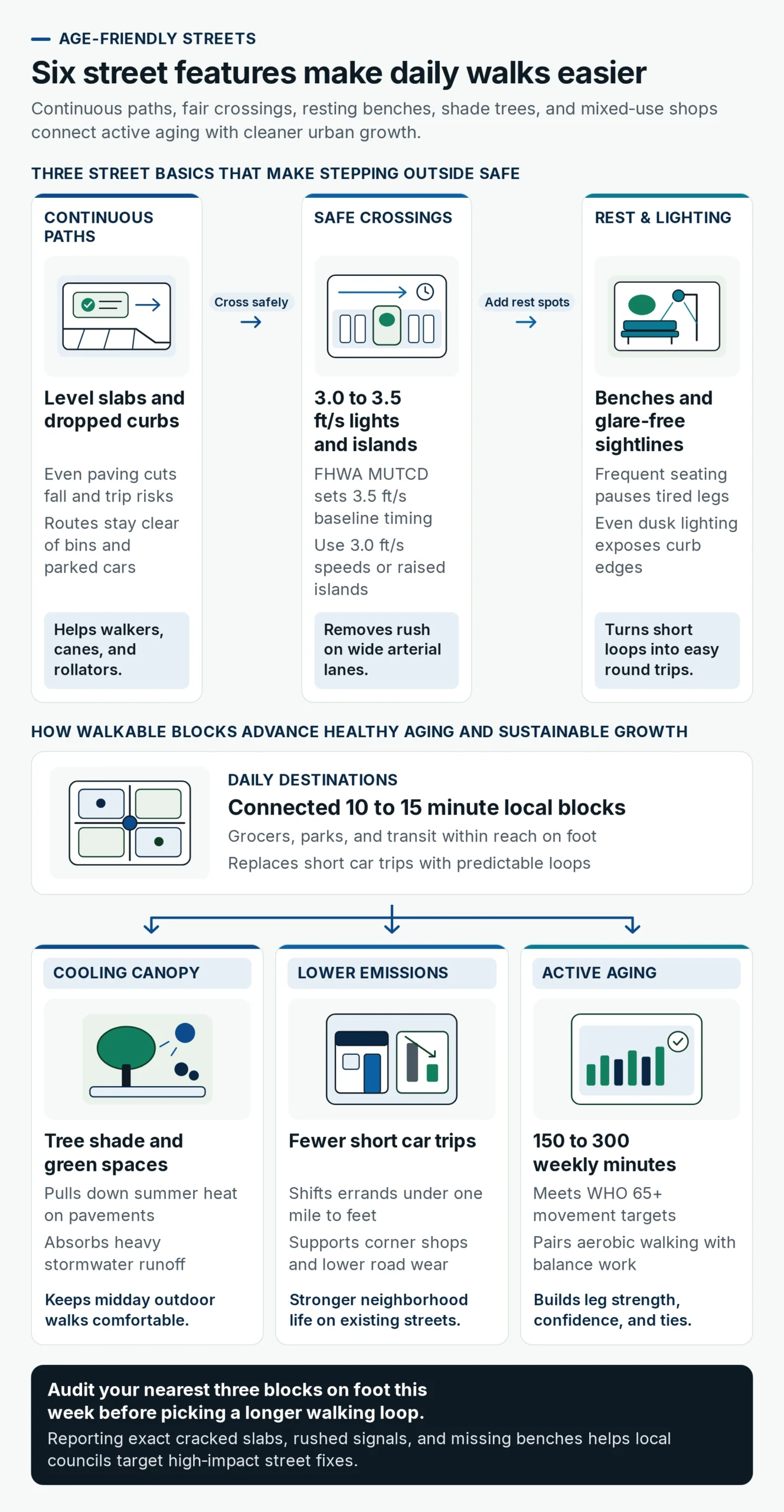
Street Design Audit: Older-Adult Benefits and Sustainable Growth
Street upgrades that help older pedestrians navigate safely deliver direct environmental and neighborhood gains at the same time. Comparing these six elements side by side shows why age-friendly streets are a practical anchor for low-carbon city planning.
| Street Feature | Older-Adult Mobility Benefit | Sustainable Growth Outcome |
|---|---|---|
| Level, obstacle-free sidewalks | Reduces trip hazards and makes walking aids practical | Replaces short car errands with zero-emission foot trips |
| 3.0 to 3.5 ft/s crossings and median islands | Prevents mid-crossing stress on wide arterial roads | Encourages calmer traffic flow around mixed-use streets |
| Tree canopy and green street planters | Lowers summer heat stress along exposed walking routes | Cools urban heat islands and absorbs heavy stormwater |
| Shaded resting benches along routes | Extends comfortable range for slower walkers | Supports longer stays at independent local high streets |
| Nearby grocers, pharmacies, and clinics | Keeps social ties and routine independence strong | Cuts vehicle miles travelled across residential blocks |
| Low local speed limits and dropped curbs | Improves wheelchair, rollator, and low-vision access | Builds durable, walkable blocks that hold long-term value |
Walking With a Purpose and Green Spaces
Daily walks stick far better when errands, social catch-ups, and shaded Parks and green spaces turn routine movement into part of an ordinary morning. Strolling to buy fresh bread, drop off a parcel, or meet a neighbor on a shaded park bench feels natural compared with forced exercise sessions.
Those trees and pocket parks work hard for city sustainability too. Mature street canopies pull down summer pavement temperatures for older walkers sensitive to heat, soak up stormwater during heavy rain, and give neighbors a shared outdoor room. Over weeks and months, short active errands maintain leg strength, confidence outdoors, and daily social contact.
Starting Gently and Auditing Your Own Street
Safe neighborhood routines support a senior restarting exercise after illness, injury, or a quiet winter without overwhelming joints or balance. Many adults outlive safe driving by roughly seven to ten years according to AARP mobility research, so building a comfortable walking route early protects long-term independence.
Because balance, stamina, and mobility aids vary widely, a five-minute street check helps residents spot barriers before reporting fixes to their local council or planning board:
- Check path continuity: Note cracked paving, sunken utility covers, parked cars on curbs, and low branches between your door and the nearest shop or transit stop.
- Test crossing timing: Walk a nearby signalized crosswalk at an ordinary pace to see whether the pedestrian phase finishes comfortably or stops short of the far curb.
- Map resting intervals and shade: Look for gaps longer than two or three blocks without a bench, handrail, or tree shade along sunny stretches.
- Log exact hazards with your municipality: Photograph missing dropped curbs or faded crosswalk paint with street names so public works teams can prioritize accessible repairs.
Building active, age-friendly neighborhoods rarely begins with grand megaprojects. Consistent pavements, fair signal timing, shaded benches, and nearby everyday errands let older adults stay active outside their own door while cutting traffic emissions across the whole block.
Frequently Asked Questions
What counts as a walkable neighborhood?
A walkable neighborhood connects homes to daily destinations such as grocers, pharmacies, parks, and transit stops within a comfortable 10 to 15 minute walk along safe, continuous, well-lit sidewalks and protected street crossings.
Are people who live in walkable cities healthier?
Urban health studies show that people who live in walkable cities record healthier cardiovascular and mobility outcomes because safe, connected streets let residents walk for groceries, parks, and transit instead of taking short car trips, helping older adults maintain leg strength, balance, and social ties.
How much crossing time do older adults need at busy streets?
While standard US traffic engineering uses 3.5 feet per second as a general pedestrian walking speed, the FHWA MUTCD advises slower timing values such as 3.0 feet per second or median refuge islands at junctions regularly used by older adults.
How do walkable neighborhoods support sustainable urban growth?
Mixed-use walkable blocks reduce short high-emission car journeys, strengthen neighborhood small businesses, pair cleanly with street trees that cool urban heat islands and filter stormwater, and stretch public infrastructure budgets over compact land.