ESOS Phase 4: UK Qualification, Deadlines and Audit Rules

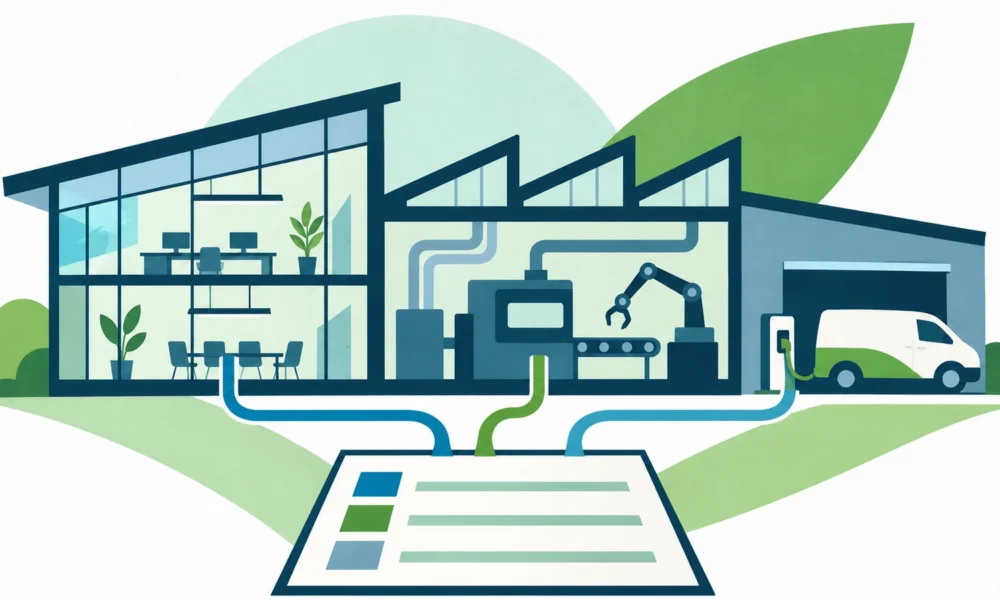
Check whether your UK undertaking or any UK undertaking in your corporate group qualifies for ESOS Phase 4 on 31 December 2026. The size test is at least 250 employees or both annual turnover above £44 million and an annual balance sheet total above £38 million. Qualifying participants must submit a compliance notification through MESOS by 5 December 2027.
Two December dates matter for UK organisations under the Energy Savings Opportunity Scheme (ESOS). The second Phase 3 progress update is due on 5 December 2026 for participants who have to report against that phase’s action plan. 31 December 2026 is the qualification date for Phase 4. A group may have obligations under both.
- Use the applicable accounts and average monthly employee count. Check the two-accounting-period rule if an undertaking has grown or shrunk.
- Calculate total UK energy use over a 12-month period. For the standard assessment, cover at least 95% through energy audits, ISO 50001 certification or both.
- If a Phase 3 action plan was required, Phase 4 generally asks why measures due by the 2027 compliance date will remain unimplemented.
- After notification, participants with energy consumption submit an action plan in 2028 and annual progress updates in 2029, 2030 and 2031.
Who has to comply with ESOS Phase 4?
Apply the two size tests to each UK undertaking. For the 250-employee test, use the average of the monthly employee totals for the relevant accounting period. Count part-time staff and people directly employed overseas by the UK undertaking. An overseas undertaking with a UK establishment follows separate employee-counting rules. For the financial test, check that annual turnover is above £44 million and the annual balance sheet total is above £38 million using the undertaking’s applicable accounts. An annual balance sheet total of exactly £38 million falls short of the financial test. Environment Agency guidance on qualification explains the cases that need particular care.
A large undertaking usually retains that status until it meets the smaller-size definition for two consecutive accounting periods. The same principle applies in reverse. A firm that has averaged 252 employees for one accounting period after years below both tests should check its prior periods and group membership before assuming it qualifies.
If one UK undertaking qualifies as large, the rest of the UK corporate group generally has to take part, subject to the guidance’s exclusions. A shared overseas parent can bring other UK undertakings into scope. The highest UK parent normally takes responsibility for its part of the group, although written agreements can change how undertakings participate. A subsidiary that leaves a qualifying group after the qualification date generally retains its obligation. If your group has acquired or sold a business, check the Environment Agency’s rules on changes to corporate groups before assigning its energy use. Specialist help with ESOS Phase 4 can be useful where responsibility is unclear.
What are the ESOS Phase 4 deadlines?
The government’s ESOS Phase 4 compliance guidance sets out the qualification date and MESOS filing timetable. For a participant that reports energy consumption, the timetable runs from qualification in 2026 to the third progress update in 2031.
- 31 December 2026: Establish whether the undertaking or group qualifies.
- 5 December 2027: Complete the applicable assessment and sign-off, and submit the compliance notification in MESOS.
- 5 December 2028: Submit the Phase 4 action plan.
- 5 December 2029, 2030 and 2031: Submit one progress update each year on the Phase 4 action plan.
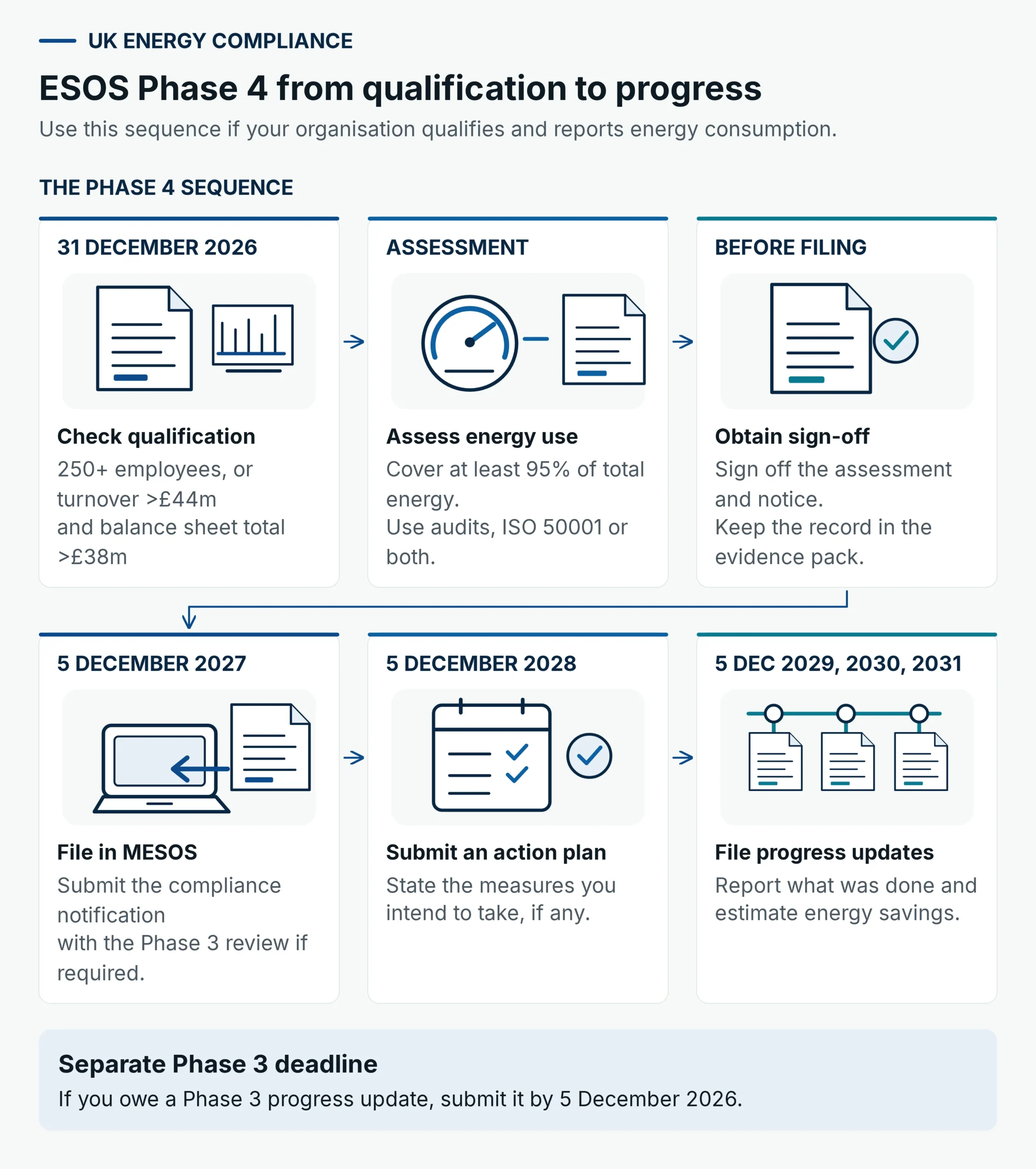
If your organisation owes the Phase 3 progress update on 5 December 2026, file it in MESOS with the required sign-off. That obligation relates to the earlier action plan. Check the Phase 3 guidance alongside your Phase 4 status.
How to assess and cover your energy use
Calculate total UK energy use over one period of 12 consecutive months that includes 31 December 2026 and ends before 5 December 2027. That period is for the total consumption calculation. Individual audits may use other eligible 12-month periods for particular assets or activities.
Use the total as the starting point for coverage. If you choose to identify significant energy consumption, the assets and activities you select must account for at least 95% of the total. Cover that amount with one or more qualifying energy audits, qualifying ISO 50001 certification or both. If you do not make that selection, the standard assessment covers the full total. Display Energy Certificates and Green Deal Assessments ceased to be accepted routes in Phase 4.
Calculate energy intensity ratios for the purposes for which you use energy. For example, a warehouse that uses 240,000 kWh for building operations over the reference period and has 6,000 m² of floor area has a building intensity ratio of 40 kWh/m². Keep the source and any estimation method in your evidence pack so someone else can reproduce the calculation.
Most audit-route participants need a lead assessor. There is an exception when total energy consumption is below 40,000 kWh. ISO 50001 certification that covers all the applicable consumption can remove the need for both a lead assessor and an ESOS report. For the compliance notification, the number of directors or equivalent signatories depends on the route. For example, an internal lead assessor requires two signatories. Check the guidance before scheduling sign-off.
What changed from Phase 3 to Phase 4?
Some rules carry over from Phase 3, including the 95% threshold and energy intensity ratios. The 2026 amendment to the ESOS Regulations changes the routes to compliance, adds a review of the previous action plan and introduces a third progress update.
| Requirement | Phase 3 | Phase 4 |
|---|---|---|
| Qualification date | 31 December 2022 | 31 December 2026 |
| Standard energy coverage | At least 95% when selecting significant energy consumption | Same threshold and continued energy intensity reporting |
| Assessment routes | Audits, ISO 50001, Display Energy Certificates or Green Deal Assessments | Audits, ISO 50001 or both |
| Earlier action plan review | No earlier ESOS action plan to review | Review required where Phase 3 plan obligations apply, subject to exceptions |
| Progress updates | Two after the Phase 3 action plan | Three after the Phase 4 action plan, ending in 2031 |
What to record about your Phase 3 action plan
If you were required to submit a Phase 3 action plan, review the measures for each relevant undertaking. Identify those you have not implemented and do not expect to implement by 5 December 2027, and explain why. Report the review with your Phase 4 notification and include it in your ESOS report where one is required. If a plan was required and nobody in the relevant group produced one, the regulations require that fact to be confirmed where applicable.
If you qualified as a participant in Phase 3 and report energy consumption in Phase 4, you also have a separate savings estimate to prepare. Report in kWh the savings achieved in the current compliance period, the share by organisational purpose and the measures behind those savings. This is a different part of the assessment from explaining unfinished Phase 3 measures.
Keep the Phase 3 review separate from your new Phase 4 action plan. The Environment Agency publishes the action plan and annual progress updates, along with much of the compliance notification. The Phase 3 review submitted with that notification stays private. The published progress updates can include estimates of energy savings and must explain the methods and data used.
What to gather before 31 December 2026
- Finance: List your UK undertakings, the applicable accounts and monthly employee totals. Record acquisitions, disposals and which undertaking will file.
- Estates and fleet: Choose the reference period. Pull bills, meter readings and fuel or mileage records. Record the reason and method where you need to estimate.
- Energy team: Retrieve the Phase 3 action plan, check which projects will finish by the 2027 compliance date and log why others are delayed or cancelled. For ISO 50001, check that the certificate covers the intended assets and activities.
How to use the audit findings after filing
Use the results to decide what to investigate first. For a site with high out-of-hours electricity use, start with operating schedules and meter readings. Compare like-for-like weeks before and after a control change. For warehouse energy waste or fuel used to locate missing fleet equipment, separate the effect of the change from differences in activity, weather or production. Use the site’s own costs and expected savings to estimate payback.
The fuel and electricity records can also help teams prepare a greenhouse gas inventory. Apply the right organisational boundary and government greenhouse gas conversion factors when turning activity data into emissions figures. A public procurement Carbon Reduction Plan under PPN 006 may require selected Scope 3 emissions as well as Scopes 1 and 2.
Questions about ESOS Phase 4
What if we have ISO 50001 for only some sites?
Use eligible certification for the energy it covers and audit the rest of the applicable consumption. You will normally need a lead assessor for this mixed route. The certificate must have been issued on or after 6 December 2023 and be valid on 5 December 2027.
Do we still have to file if we qualify but use no energy?
A qualifying participant with zero total energy consumption still files a notification. Obtain sign-off from two directors or equivalents and keep evidence of the zero-consumption position. The participant does not need an ESOS report, an action plan or annual updates.
Do we have to carry out every measure in our action plan?
You can submit an action plan stating that you intend to implement no measures. You still owe the annual progress updates if you were required to submit the plan. If you propose measures, the updates record what was done, any measures you missed by their stated dates, and the methods and data behind any savings estimates.
How we put this together

Diana Hope covers practical sustainability and green travel as a staff writer for Blue & Green Tomorrow. She joined the desk in 2019 and has written more than 260 articles on restaurant food-waste tracking, office furniture reuse, and home battery backup systems. Much of her reporting examines how operational tools help UK homes and workplaces cut waste.
- Published
- Sources
- Primary reporting
Keep moving along the spectrum
The same desk, then neighbouring desks along the brand spectrum.