Energy
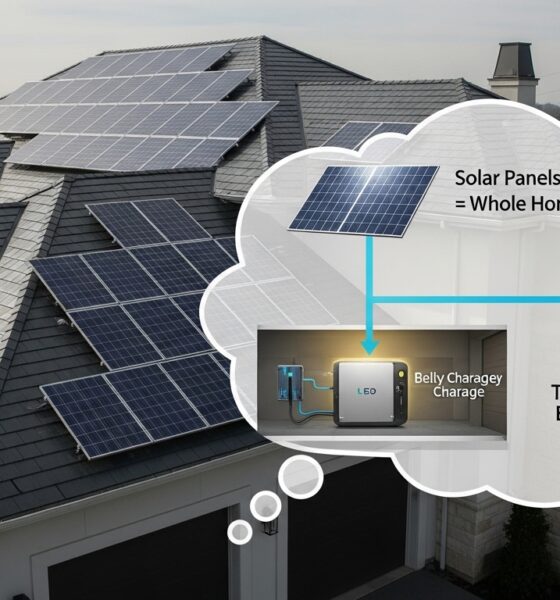
Do You Need Solar Panels for Whole Home Battery Backup?

Homeowners who begin exploring whole home battery backup systems are usually trying to solve a practical problem. They want their house to continue functioning when the electrical grid fails. Lights stay on, heating systems run, refrigeration continues, and daily routines carry on without interruption.
Getting there takes more planning than a partial backup that only covers a few circuits. Whole home backup means supporting the electrical demands of the entire house, which quickly raises an important question.
Are solar panels necessary?
Often, yes. A battery can power the home on its own, but only until its stored energy runs out. Solar panels allow that energy to be replenished while the outage is still underway. That capability becomes important when outages last longer than a few hours. Understanding why solar is often included in these systems starts by looking at the electrical demand of a typical home.
What a Whole Home Battery Backup System Must Support
A whole home battery backup system is designed to power the entire electrical panel when the grid fails. The goal is not simply protecting a refrigerator or a few lights. The goal is for the home to operate normally.
That requires supporting many electrical loads. Lighting, refrigeration, communications equipment, televisions, and computers are only part of the demand. Heating systems, air conditioning, electric cooking appliances, and well pumps also cycle on and off throughout the day.
Every house is different, but there are some useful benchmarks. A mid-sized house between roughly 2,000 and 3,000 square feet often averages 1.5 to 3 kilowatts of demand over the course of a day. Demand usually climbs in the morning and evening, when people are cooking, turning on lights, and using electronics.
When larger equipment turns on, the numbers increase quickly. A heat pump, central air conditioner, electric range, or well pump can each draw several kilowatts while operating. When several of these systems run at the same time, total demand can briefly approach 8 to 10 kilowatts.
Those peaks matter. Batteries have to cover not just how much energy the house uses in a day, but also those brief moments when the electrical current draw spikes.
Most residential batteries store 10 to 15 kilowatt hours of usable energy and deliver roughly 5 to 8 kilowatts of continuous power. A single battery can support essential loads and modest household use for a period of time, but it is rarely sufficient for full whole-home backup. That’s why most whole home systems tie several batteries together.
Installations often end up with 24 up to 50 kilowatt hours of storage, providing enough energy and output to support normal household activity during an outage.
Even with multiple batteries, however, the system still contains a finite amount of stored electricity. If an outage lasts long enough, the stored energy will eventually be depleted. Solar panels change that equation.
How Solar Extends Whole Home Backup
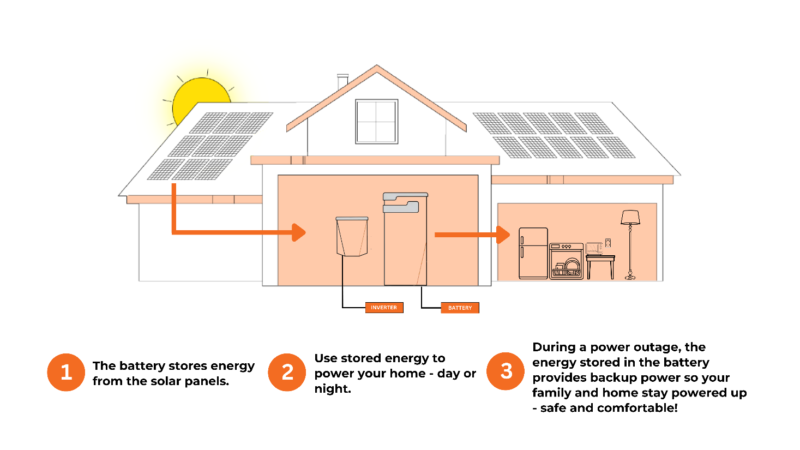
Solar panels produce electricity whenever sunlight reaches the array. When connected to a battery system, that electricity can power the home immediately or recharge the batteries for later use.
Without solar generation, a battery functions like a reservoir of stored energy. The house draws from that supply until it is empty. At that point the system must wait for grid power to return before it can recharge.
Solar introduces a second energy source. Instead of relying only on stored electricity, the home can produce new power each day.
In a longer outage, a solar-plus-battery system usually falls into a daily rhythm: panels start producing in the morning, midday solar runs the house and tops up the batteries, afternoon sun finishes the charge, and the batteries carry the home through the evening and night until the next morning.
With a properly sized system, this cycle can allow a home to remain operational through outages lasting several days, weeks and even months. Solar production offsets daytime consumption and recharges stored energy whenever sunlight is available.
When solar panels are integrated into whole home battery backup systems, several advantages appear:
• Batteries recharge during daylight hours
• Solar power supports daytime electrical demand
• Stored energy is preserved for evening and overnight use
• Multi-day outages become easier to manage
Solar does not create unlimited energy, but it significantly extends how long a home can remain powered when the grid stays down.
Generators as Part of a Backup Strategy
Some homeowners combine battery storage with a standby generator. A generator can recharge the battery bank or supply electricity directly during extended outages.
This approach may be used in areas where solar production is limited or when homeowners prefer a fuel-based backup solution. Generators require fuel, produce noise, and require periodic maintenance, but battery storage drastically reduces how often they need to run.
Instead of operating continuously, the generator may start periodically to recharge the battery system. Shorter run times reduce fuel consumption and mechanical wear.
Some homes use all three technologies together. Solar panels provide daytime electricity, the battery stores energy and delivers seamless backup power, and the generator remains available during longer outages or periods of poor solar production.
Smart Load Management
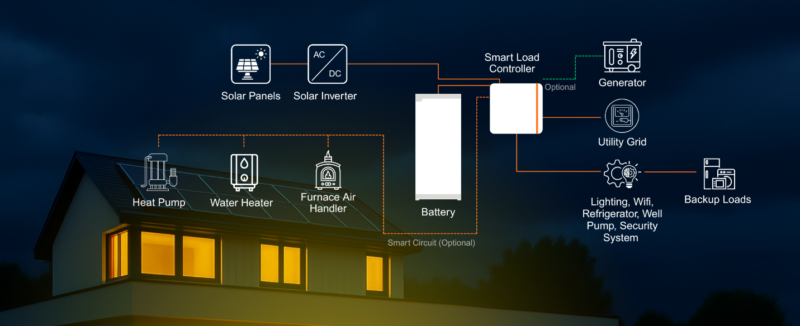
Many modern whole home battery systems include smart load management. These controls monitor electrical demand while the home is operating on backup power.
Rather than allowing every appliance to run at the same time, the system prioritizes essential circuits and moderates large loads when necessary. This prevents several major appliances from starting simultaneously and draining the batteries too quickly.
Smart circuit management can:
• Prioritize refrigeration, lighting, and communication equipment
• Limit large electrical loads such as secondary HVAC systems
• Coordinate heating and cooling equipment
• Adjust thermostats automatically when energy levels decline
• Send alerts when battery levels become low
These controls allow a battery system to support a home longer than it could if every circuit operated without limits.
Designing the Right System
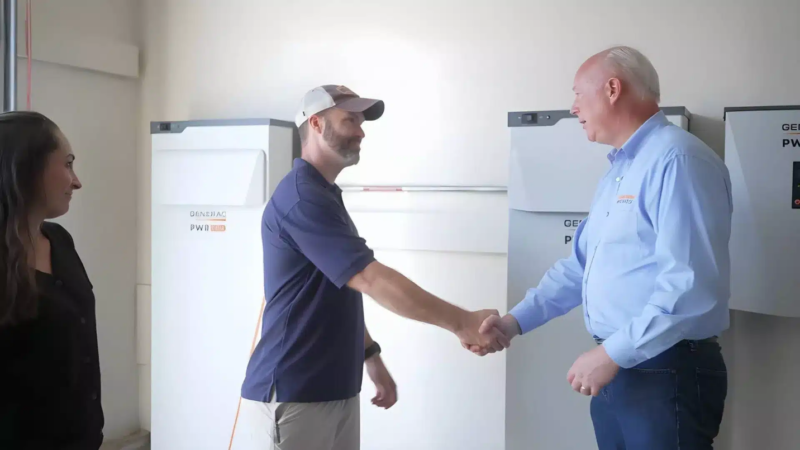
Every whole-home backup system ends up a little different. Every house has its own electrical profile, and the system must reflect how energy is actually used.
Electrical engineers or experienced system designers evaluate household demand and determine how major equipment behaves during an outage. Heating equipment, air conditioning, electric cooking appliances, and well pumps all influence system sizing.
Several factors guide the design:
• Home size and layout
• Heating and cooling equipment
• Daily electricity consumption
• Expectations during outages
Whole home backup systems are engineered rather than simply installed. Proper design ensures that solar generation, battery storage, and generator support work together and that the system can meet the actual electrical demands of the home.
Keeping the Lights On When the Grid Is Down
Power outages are becoming more common in many areas. Severe weather, aging infrastructure, and rising electricity demand are placing increasing pressure on electrical grids.
Battery storage is one way to keep a home powered during outages. When solar generation is included in the design, the system can produce electricity each day and store it for nighttime use.
For homeowners considering whole home battery backup, the combination of solar generation and battery storage offers one of the most dependable ways to keep a house running when the grid fails.
FAQs
Can a home battery work without solar panels?
Yes. A battery can back up a home without solar, but once its stored energy is used up it has no way to recharge during an outage unless you also have solar or a generator.
How long can a whole home battery power a house?
It depends on the size of the battery system and how much electricity the home is using. A single battery might cover only a few hours, while larger systems with several batteries can keep a house running much longer.
How many batteries are needed for a whole home backup?
Many homes end up using two to four batteries for whole-home backup, but the exact number depends on the home’s electrical load and how “normal” you want life to feel during an outage.
What happens if an outage lasts several days?
Solar panels can recharge the batteries during daylight hours, and some homes also use generators as a backup when solar production is limited or demand is high.
Can battery systems manage large appliances automatically?
Many modern systems include smart controls that prioritize essential circuits and limit or delay large loads, so big appliances do not all run at once and drain the batteries too quickly.













Occupational Safety’s Overlooked Role in Environmental Accountability

Sustainable Commuting in Loveland: Balancing a Lower Carbon Footprint With Road Safety

What Separates a Career Shaping Environmental Policy From One Shaping Corporate Sustainability

The Human Primary Cells Behind Toxicology and Chemical-Safety Research

How Sustainable Business Has Changed in the Last Five Years: An Interview with Noa Shtang

The Green Traveler’s Guide to Bali Snorkeling and Diving – Low-Impact Ways to See the Reef

Why Eco-Tourists Choose the Liveaboard in Komodo

Eating Out Abroad? ePOS Systems Are Quietly Cutting Food Waste

PMS for Hotels Explained – The Hidden Software Making Your Stay Greener

The Eco-Case for a Liveaboard – Why the Greenest Way to See a Reef Might Be a Boat

 Economy11 months ago
Repairing vs. Recycling: Why Fixing Delivers Bigger Gains
- Energy9 months ago
Where The Wind Falters: Key Challenges In Wind Turbine Blade Repair
- News7 months ago
Collisions Involving Sudden Door Openings from Parallel-Parked Cars
- Energy7 months ago
Neel Somani Discusses the Energy Market Design and How Pricing Actually Works