
Features
Why Outdoor Offices Are the Future of Sustainable Work

The spare-room home office is starting to look like a stopgap rather than a solution. Research from Cornell University and Microsoft, published in PNAS, found that fully remote workers have a carbon footprint up to 54% lower than onsite workers, and where you work at home shapes how much of that saving you keep. That’s why a growing number of remote workers are moving out of the box room and into a purpose-built outdoor office: a dedicated garden workspace that pairs sustainable design with better focus, lower bills and a proper boundary between work and life.
Key Takeaways
- Fully remote work can cut your work-related carbon footprint by 54% (Cornell/Microsoft, PNAS 2023); an efficient outdoor office protects that saving.
- Space heating consumes 61.5% of household energy (Eurostat, 2024), so heating one small insulated room beats heating the whole house.
- A quality garden office can add 5–15% to a home’s value (Unbiased, 2024).
What Is a Personal Outdoor Office?
A personal outdoor office is a standalone, insulated workspace in your garden, engineered for year-round use with mains power, reliable connectivity and proper climate control. With 28% of working adults in Great Britain now hybrid working and a further 14% working from home full-time (ONS, 2025), demand for these buildings has shifted from novelty to necessity.
How is that different from working on the patio? Entirely. A patio setup is seasonal and improvised. A purpose-built garden office is a permanent, ergonomic room with a front door you can close at 5:30pm. That physical separation matters more than it sounds, and we’ll come back to why.
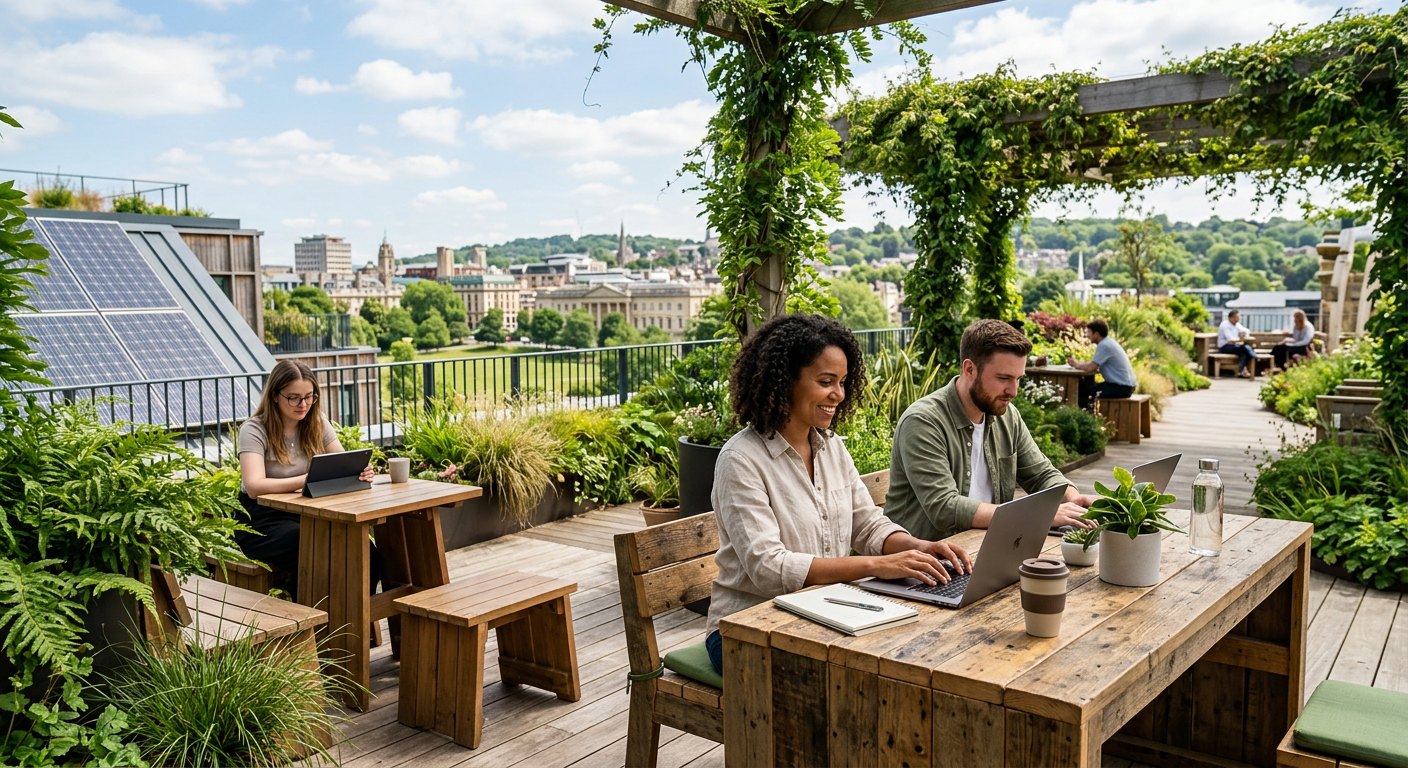
A purpose-built garden office creates a year-round workspace and a clear boundary between work and home.
How Much Carbon Can an Outdoor Office Actually Save?
The baseline is already impressive. According to the Cornell University and Microsoft study published in PNAS, switching from onsite to fully remote work reduces a worker’s employment-related emissions by up to 54%, while hybrid workers at home two to four days a week cut theirs by 11–29% (PNAS, 2023). A well-designed outdoor office is how you stop household energy use from eating into that saving.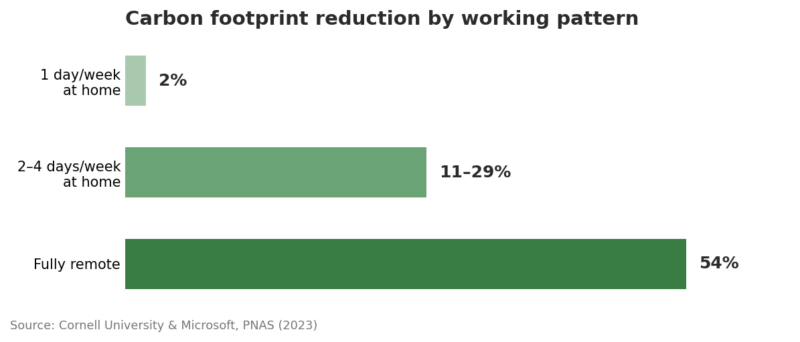
Carbon footprint reduction by working pattern 1 day/week at home 2% 2–4 days/week at home 11–29% Fully remote 54% Source: Cornell University & Microsoft, PNAS (2023) Emissions savings scale sharply with days worked from home. Source: Cornell/Microsoft, PNAS (2023).
Why does heating one small room beat heating the house?
Space heating accounts for 61.5% of household final energy consumption, and heating plus hot water together take 77.1% (Eurostat, 2024). Keep the whole house at working temperature for eight hours a day and that’s where your remote-work carbon saving quietly leaks away. A compact, well-insulated garden room holds heat with a fraction of the energy, and for much of spring and autumn, cross-ventilation and solar gain through glazing do the job for free.
How much energy does natural light save?
Quite a lot, and not just on the meter. Full-height glazing designed around the sun’s path can displace artificial lighting for most of the working day. Cornell research led by Professor Alan Hedge also found that workers in optimised daylight reported an 84% drop in eyestrain, headaches and blurred vision. So the same design choice cuts electricity use and screen fatigue at once. Not a bad trade.
What about the carbon cost of building it?
Embodied carbon is where prefabricated garden offices tend to win. Factory-built modular structures generate less material waste than on-site construction of a house extension, and timber builds lock carbon into the structure itself. Choosing FSC-certified timber, sheep’s-wool or recycled insulation and a supplier that manufactures locally keeps the footprint of the build proportionate to the emissions it will go on to save. Rainwater harvesting off the roof adds a small but genuinely useful bonus: free irrigation for the garden around it.
Do Outdoor Offices Really Make You More Productive?
The evidence says yes, through two mechanisms: light and nature. A global Human Spaces study of 7,600 office workers across 16 countries found that people working with natural elements such as daylight and greenery reported 6% higher productivity, 15% higher creativity and 15% higher wellbeing than those without. A garden office is arguably the most direct way a remote worker can put that finding to use.
How does being near nature reduce stress?
Measurably, and quickly. A University of Michigan study published in Frontiers in Psychology found that spending just 20–30 minutes in a setting that feels natural produces the steepest drop in cortisol, the body’s main stress hormone (Frontiers in Psychology, 2019). When your desk sits in the garden, that dose of nature isn’t something you schedule. It’s the view from your chair and the 30-second walk to your door.
Will it lower my energy bills?
In most cases, yes. Because heating dominates household energy costs, conditioning a 10–15m² insulated room instead of an entire house during working hours directly trims the winter bill. Passive design features (south-facing glazing, thermal mass, shading for summer) reduce how often the heater or cooling unit runs at all. In our experience, owners who add a small solar array to the roof often run the office at close to zero marginal cost.
Does the commute-free boundary actually help?
This tends to be the benefit owners mention first. A separate building creates physical and psychological distance between work and home, which makes switching off at the end of the day far easier than closing a laptop on the kitchen table. You keep the two-minute commute and lose the temptation to answer one more email from the sofa. That separation, not the timber cladding, is what most buyers are really paying for.
Daylight and a view of greenery are linked to higher productivity, creativity and wellbeing.
Does a Garden Office Add Value to Your Home?
A high-quality garden office can add between 5% and 15% to a property’s value, which on a £400,000 home means roughly £20,000–£40,000 (Unbiased, 2024). Treat the top of that range with some caution: research from The Property Centre, reported by Property Reporter in 2024, put the average uplift at a more grounded 8.4%, around £22,700. Either way, the direction is clear. With hybrid working now standard for over a quarter of the workforce, a finished, insulated workspace is a feature buyers actively search for, not a nice-to-have. Build quality decides the outcome: a properly insulated, professionally finished room adds value, while a glorified shed can subtract it.
What Makes a Personal Outdoor Office Effective?
Four design pillars separate a year-round workspace from an expensive summerhouse. Get these right and the building earns its keep in January as well as June.
Weather-adaptive infrastructure
Insulated walls, floor and roof are non-negotiable in a UK climate. Beyond that, the smarter end of the market now offers automated shading, motorised pergolas and smart glass that adjusts its tint to sunlight levels, keeping the room comfortable without running heating or cooling constantly.
Technology integration
Weatherproof sockets, a dedicated outdoor-rated Wi-Fi 6E access point and a hardwired ethernet run back to the house are worth specifying at build stage. A dedicated access point delivers noticeably better range and stability than a mesh repeater perched on a windowsill, and trenching cable after the fact costs far more than doing it during installation.
Biophilic design
This is where the Human Spaces findings become a specification sheet: maximise daylight, frame views of planting, use natural materials like exposed timber, and bring plants inside. The same global study linked office design to retention as well, with a third of workers saying workspace design would influence whether they’d take a job. Your garden office should pass the same test.
Accessibility and space optimisation
A level, well-lit path from house to office, a door threshold that works for everyone, and ergonomic furniture sized to the room all extend who can use the space and for how long. In small gardens, modular shelving and fold-away furniture keep a compact footprint genuinely usable. Lighting that supports circadian rhythm (bright and cool by day, warmer by evening) rounds out a room you can work in comfortably through every season.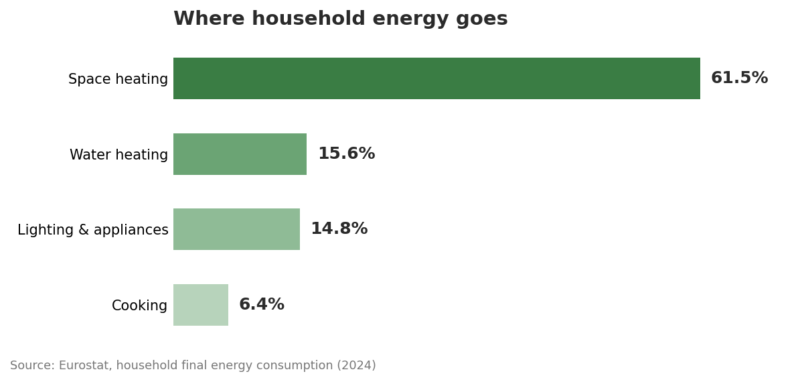
Where household energy goes Space heating 61.5% Water heating 15.6% Lighting & appliances 14.8% Cooking 6.4% Source: Eurostat, household final energy consumption (2024) Space heating dominates household energy use, which is why conditioning one small room beats conditioning the whole house. Source: Eurostat (2024).
Frequently Asked Questions
Do I need planning permission for a garden office in the UK?
Usually not. Most garden offices fall under permitted development rights if they stay under 2.5m tall when built within 2m of a boundary and are used incidentally to the home. Listed buildings, conservation areas and business use with client visits can change that, so check with your local planning authority first.
How much does a garden office reduce my carbon footprint?
Fully remote work already cuts work-related emissions by up to 54% (Cornell/Microsoft, PNAS 2023). An insulated garden office protects that saving by letting you heat one small room rather than a whole house, since space heating alone accounts for 61.5% of household energy use (Eurostat, 2024).
Can I use a garden office all year round?
Yes, provided it’s built for it. Insulated walls, floor and roof, double glazing and a modest heating source keep a quality garden room comfortable through winter, while shading, ventilation and smart glass manage summer heat. Uninsulated summerhouses, by contrast, are realistically three-season spaces.
How much value does a garden office add to a house?
Estimates range from 5% to 15% of property value, with 2024 research reported by Property Reporter putting the average uplift at 8.4%, around £22,700 (Unbiased, 2024). Build quality, insulation and a professional finish determine where in that range a specific building lands.
What’s the difference between a garden office and a shed conversion?
Insulation, foundations and services. A garden office is engineered as a habitable room with certified electrics, damp-proofing and thermal performance for year-round use. A converted shed rarely achieves that, tends to suffer condensation and cold, and adds little or no property value as a workspace.
Conclusion: A Workspace That Pays You Back Three Ways
The personal outdoor office isn’t a lockdown leftover. It’s the logical next step for the 42% of British workers who now spend at least part of their week working from home. The numbers stack up in three directions at once: emissions (protecting a carbon saving of up to 54%), wellbeing (measurable drops in stress and eyestrain, gains in focus and creativity) and money (lower running costs plus a 5–15% property uplift).
Where do you start? Check your local planning rules, then prioritise the boring fundamentals: insulation, glazing orientation, a proper power and data connection. Get those right and you’ll have built something rare, a home improvement that’s better for your work, your health, your bills and the planet at the same time.





The Human Primary Cells Behind Toxicology and Chemical-Safety Research

How Sustainable Business Has Changed in the Last Five Years: An Interview with Noa Shtang

The Green Traveler’s Guide to Bali Snorkeling and Diving – Low-Impact Ways to See the Reef

Why Eco-Tourists Choose the Liveaboard in Komodo

Eating Out Abroad? ePOS Systems Are Quietly Cutting Food Waste

PMS for Hotels Explained – The Hidden Software Making Your Stay Greener

The Eco-Case for a Liveaboard – Why the Greenest Way to See a Reef Might Be a Boat

Future-Proofing the Sustainable Workplace: Integrating Solar PV and Smart EV Infrastructure

Why Outdoor Offices Are the Future of Sustainable Work

How Eco-Conscious People Can Find Careers in Healthcare

 Features11 months ago
Top Agricultural Stocks to Watch
- Sustainability11 months ago
Sustainable Travel in Christchurch: A Greener Way to Explore
- Features11 months ago
Staying Healthy on the Road: Eco-Conscious Habits for Global Travelers
- Economy10 months ago
Repairing vs. Recycling: Why Fixing Delivers Bigger Gains