Features
Half of UK offices send furniture to landfill. Why is nobody talking about it?

One of the things that we have written a lot about since Ryan took over as the owner of Blue and Green Tomorrow is recycling. Something that deserves more attention is how much office furniture, shop fittings and other business furnishings are thrown away before they have truly reached the end of their useful lives. It is a problem that links waste, carbon emissions, resource use and the rising pressure on landfill space across the UK.
Another thing businesses need to understand is that furniture disposal is not only a housekeeping issue. Old desks, chairs, sofas, wardrobes, cabinets and bed bases can all carry an environmental cost when they are treated as rubbish instead of assets that could be repaired, donated, resold or recycled. Keep reading to learn more.
Furniture Waste Has a Hidden Environmental Cost
Paula Gibson of the Waste to Wonder blog reports that the UK discards approximately 670,000 tonnes of furniture and furnishings every year from households alone, which is equal to roughly 22 million items. There are also business items being cleared from offices, hotels, schools, shops and rental properties, which means the wider furniture waste problem is even larger than household figures suggest. “Typical disposal journeys illustrate the problem: a good condition sofa collected as bulky waste routed to energy-from-waste; a wardrobe taken to an HWRC and shredded for material recycling despite being repairable; a bed base sent to landfill due to contamination concerns. Fast furniture compounds the issue. Low-cost chipboard and composite component parts fail after 3–5 years versus 15–20 for solid wood, making them less attractive for reuse organisations to collect and redistribute. Much discarded furniture could have a new lease of life if convenient services existed,” Gibson writes. It is easy to see why businesses should rethink disposal before sending usable furniture to landfill.
A report from the Department for Environment, Food & Rural Affairs states that the provisional UK recycling rate for waste from households, including Incinerator Bottom Ash metal, was 44.6% in 2023, up from 44.1% in 2022. “UK estimates for biodegradable municipal waste (BMW) to landfill have been calculated using a UK wide approach in accordance with relevant legislation. Biodegradable municipal waste is the fraction of municipal waste that will degrade within a landfill site. Amongst other materials it will include food waste, green waste, cardboard and paper.” It is a reminder that progress on recycling still leaves a large share of waste needing better handling. Something that businesses can do is cut disposal at the source by choosing reuse and repair before collection day arrives.
There are several environmental harms linked to sending furniture to landfill. It is not only the space taken up by bulky items, but also the wasted timber, metal, plastic, foam, fabric and energy that went into making and moving those products. Businesses that replace furniture often can raise their carbon footprint if they buy new items while sending usable ones away as waste. Another thing to consider is that poor-quality furniture can make the cycle worse because it breaks sooner and is harder to pass on.
When businesses talk about sustainability, the conversation often centres around energy efficiency, electric vehicles and reducing single-use plastics.
Yet there is another environmental issue quietly unfolding in offices across the UK: furniture waste.
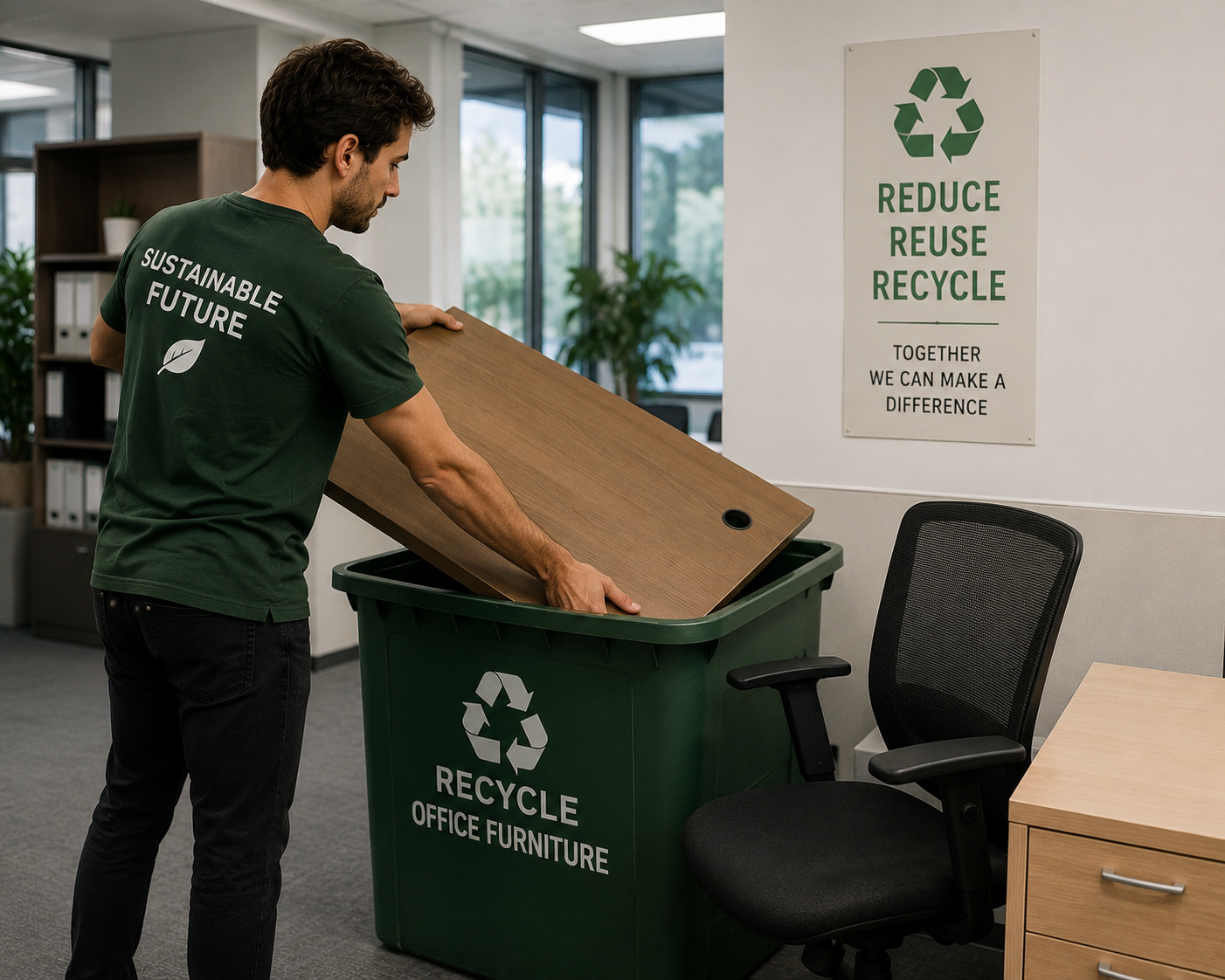
Every year, millions of desks, chairs and storage units are removed from workplaces during office moves, refurbishments and downsizing projects. While many of these items are still perfectly usable, a significant proportion still end up being treated as waste.
According to workplace industry research, UK offices discard around 1.2 million desks and 1.8 million office chairs every year. The same report estimates that around 300 tonnes of office furniture is sent to landfill every working day.
At a time when businesses are under growing pressure to improve their environmental credentials, these figures raise an uncomfortable question: why are so many usable assets still being thrown away?
The hidden waste stream businesses rarely measure
Unlike packaging waste or food waste, office furniture rarely appears on sustainability dashboards.
Many organisations only think about furniture when they are moving premises, redesigning a workspace or closing an office. Decisions are often made under tight deadlines, with facilities teams focused on leaving a building quickly rather than finding reuse opportunities.
The result is that desks, chairs, filing cabinets and meeting room furniture are frequently disposed of through general waste streams.
Research published by Workplace Insight found that while 86% of facilities managers considered their furniture management approach to be sustainable, around half of organisations still relied on general waste disposal routes for unwanted furniture.
This gap between perception and reality highlights a wider challenge. Businesses may have ambitious ESG goals, but furniture management often remains an overlooked part of the sustainability picture.
Why throwing away office furniture has a bigger impact than many realise
Furniture carries a substantial environmental footprint long before it arrives in an office.
The manufacturing process requires raw materials including timber, steel, plastics and textiles. Energy is consumed throughout production, transportation and installation.
When a desk or chair is discarded after only a fraction of its usable life, all of those embedded resources are effectively wasted.
Research from WRAP suggests that reusing or refurbishing furniture can avoid up to 80% of the embodied carbon associated with purchasing new products. In many cases, extending the life of existing furniture delivers a far greater environmental benefit than recycling it at the end of its life.
The issue becomes even more significant when multiplied across thousands of offices nationwide.
The rise of the circular workplace
A growing number of organisations are beginning to adopt what sustainability experts call a circular economy approach.
Rather than viewing furniture as disposable, businesses are increasingly looking at ways to keep assets in use for longer through refurbishment, redistribution, resale and recycling.
This approach not only reduces waste but can also lower procurement costs and help organisations meet increasingly stringent ESG targets.
Many companies are now carrying out furniture audits before office moves, identifying items that can be reused elsewhere within the business and ensuring unwanted furniture is diverted away from landfill wherever possible.
Sustainability starts before the skip arrives
According to a spokesperson at SFI Logistics, a company that offers commercial furniture removal and recycling, businesses often underestimate how much furniture can be reused when an office is cleared.
“One of the biggest misconceptions we see is that office furniture has reached the end of its life simply because a company is moving premises or redesigning a workspace. In reality, many desks, chairs and storage units are still perfectly usable.
“The most sustainable piece of furniture is usually the one that already exists. Through responsible office clearance, recycling and reuse programmes, businesses can dramatically reduce the amount of material going to landfill while also supporting their wider sustainability goals.
“We’re seeing more organisations ask for detailed reporting on what has been recycled, reused or diverted from landfill because they increasingly recognise that office clearances are an important part of their ESG strategy.”
A sustainability challenge hiding in plain sight
It is better for companies to treat unwanted furniture as part of their sustainability planning rather than as a last-minute clearance job. You can often reduce harm by planning office moves earlier, finding charities or reuse partners, separating recyclable materials, buying longer-lasting furniture and choosing suppliers that offer take-back schemes.
Something that may seem like a small disposal choice can become a larger environmental problem when thousands of businesses make the same decision. There are better options than landfill, and businesses that choose reuse, resale, repair or recycling can cut waste while showing customers and staff that they take environmental responsibility seriously.
The UK’s office furniture waste problem is unlikely to attract the same headlines as plastic pollution or carbon emissions from transport.
Yet the scale of the issue suggests it deserves far greater attention. If offices are sending 300 tonnes of furniture to landfill every working day, there is clearly significant room for improvement.
As businesses continue to refine their sustainability strategies, office furniture may become one of the easiest areas in which to make measurable progress. The challenge is ensuring that perfectly usable desks and chairs are seen as assets with value, rather than waste waiting for a skip.
After all, the greenest piece of office furniture is often not a new one made from sustainable materials. It’s the one that never needed replacing in the first place.















Occupational Safety’s Overlooked Role in Environmental Accountability

Sustainable Commuting in Loveland: Balancing a Lower Carbon Footprint With Road Safety

What Separates a Career Shaping Environmental Policy From One Shaping Corporate Sustainability

The Human Primary Cells Behind Toxicology and Chemical-Safety Research

How Sustainable Business Has Changed in the Last Five Years: An Interview with Noa Shtang

The Green Traveler’s Guide to Bali Snorkeling and Diving – Low-Impact Ways to See the Reef

Why Eco-Tourists Choose the Liveaboard in Komodo

Eating Out Abroad? ePOS Systems Are Quietly Cutting Food Waste

PMS for Hotels Explained – The Hidden Software Making Your Stay Greener

The Eco-Case for a Liveaboard – Why the Greenest Way to See a Reef Might Be a Boat

 Features12 months ago
Top Agricultural Stocks to Watch
- Features12 months ago
Staying Healthy on the Road: Eco-Conscious Habits for Global Travelers
- Economy11 months ago
Repairing vs. Recycling: Why Fixing Delivers Bigger Gains
- Energy9 months ago
Where The Wind Falters: Key Challenges In Wind Turbine Blade Repair