News
Greenpeace darkens site for internet censorship
Greenpeace’s website darkened in support of Wikipedia and other websites against the US government who are debating bills that censor the internet. Charlotte Reid has more.
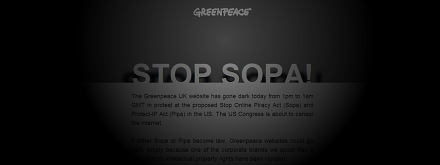
The Greenpeace UK website went into blackout for 12 hours between 1pm until 1am yesterday in protest of the proposed Stop Online Privacy Act (SOPA) and Protect-IP Act (PIPA) in the US.

Greenpeace’s website darkened in support of Wikipedia and other websites against the US government who are debating bills that censor the internet. Charlotte Reid has more.
The Greenpeace UK website went into blackout for 12 hours between 1pm until 1am yesterday in protest of the proposed Stop Online Privacy Act (SOPA) and Protect-IP Act (PIPA) in the US.
Kumi Naidoo, the executive director of Greenpeace International, posted a blog on their website explaining why they were protesting the bills. He said, “In the history book of bad ideas, the concept of giving corporations the right to censor the internet has to rank among the worst ever”.
Naidoo said that if the two bills were to go through US Congress and Senate the impact would cause a “riotous ruckus among free speech activists around the world”.
A number of websites on January 18th went into blackout to protest the two bills going through the US Congress.
The most notable website that went offline for the day was the English Wikipedia site. SOPA and PIPA are supposed to help tackle online piracy, in particular illegal copies of films. But Wikipedia’s founder, Jimmy Wales, told the BBC that opposition to the bill is more than that, “Proponents of SOPA have characterised the opposition as being people who want to enable piracy or defend piracy.
“But that’s not really the point. The point is that the bill is so over broad and so badly written that it’s going to impact all kinds of things that, you know, don’t have anything to do with piracy.”
This rings true as to why Greenpeace are supporting the protest. Whilst the bills would try to curb movie and music piracy, it could potentially have an impact on online activism too. They say that corporations would be able to shut down websites that they believe are infringing their copyright, and would not have to go to court.
Greenpeace has been involved in many court cases because of some of their campaigns spoofing major corporations advertising. These include a mock Star Wars advert in 2011 to show the ‘dark side of VW’ because they were part of a group lobbying against new laws to help cut C02 emissions and reduce oil use.
Another example is a Kit Kat advert which highlighted Nestlé’s involvement in rainforest destruction from palm oil production. Nestlé then tried to remove the video for trademark violation.
Naidoo said that “While court case after court case has agreed with us that parody is a protected form of free speech, the corporations at the pointy end of our parodies tend to disagree”.
The site said, “More than ever, the networked world is holding corporate interests accountable for their environmental and human rights abuses. Don’t let people power be silenced”.
If you want to help companies that care about the environment and ethics then talk to your financial adviser. If you don’t have one then fill in our online form and we will put you in touch with a specialist financial adviser.
Or if you want to shop at places that take their social responsibility seriously then visit the Ethical Superstore.














Occupational Safety’s Overlooked Role in Environmental Accountability

Sustainable Commuting in Loveland: Balancing a Lower Carbon Footprint With Road Safety

What Separates a Career Shaping Environmental Policy From One Shaping Corporate Sustainability

The Human Primary Cells Behind Toxicology and Chemical-Safety Research

How Sustainable Business Has Changed in the Last Five Years: An Interview with Noa Shtang

The Green Traveler’s Guide to Bali Snorkeling and Diving – Low-Impact Ways to See the Reef

Why Eco-Tourists Choose the Liveaboard in Komodo

Eating Out Abroad? ePOS Systems Are Quietly Cutting Food Waste

PMS for Hotels Explained – The Hidden Software Making Your Stay Greener

The Eco-Case for a Liveaboard – Why the Greenest Way to See a Reef Might Be a Boat

 Energy9 months ago
Where The Wind Falters: Key Challenges In Wind Turbine Blade Repair
- Economy11 months ago
Repairing vs. Recycling: Why Fixing Delivers Bigger Gains
- News7 months ago
Collisions Involving Sudden Door Openings from Parallel-Parked Cars
- Energy7 months ago
Neel Somani Discusses the Energy Market Design and How Pricing Actually Works